Table of Contents

Learning: For Business

1. Subject Expertise

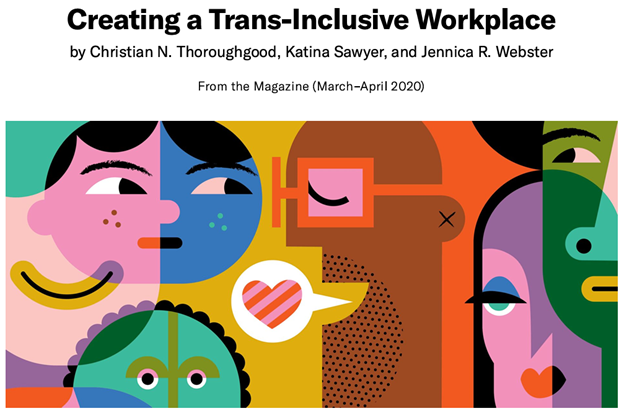
harvard law review trans workplace article cover image
Harvard Law Review (2020)

“Despite a growing global awareness of the struggles trans people face, many employers remain ill-equipped to create the policies and workplace cultures that would support trans employees. Part of the problem is a lack of knowledge about these challenges. Indeed, even companies that are LGBTQ+-friendly usually focus more on the ‘LGB’ than on the ‘TQ+.’”

jenn burleton cartoon avatar

We’re aware that you (and/or your company) may have some reservations about having this conversation right now.

Depending on where your company is based, pressure not to engage in discussions about workforce diversity may come from a variety of internal and external voices, for a wide variety of reasons.

And still, the transgender-spectrum workforce is significant (2 million+), young, and growing.

50% of the transgender workforce are people of color.
71% of the transgender workforce are people under age 35.

2. The Future

As younger generations (Gen Z and Millennials) report higher rates of identifying as transgender or nonbinary, the representation of transgender people in the workforce is expected to grow.

3. Law & Policy

Title VII

Understanding labor market views toward trans people is important, especially in the context of the 2020 U.S. Supreme Court decision in Bostock v. Clayton County, which ruled that transgender people are legally protected from discrimination in employment. Unless your business has 15 or fewer employees, there are no exceptions to this ruling.

Equal Employment Opportunity Commission (EEOC)

In the words of Supreme Court Justice Neil Gorsuch (Bostock v. Clayton County): [emphasis ours]

“An individual’s homosexuality or transgender status is not relevant to employment decisions. That’s because it is impossible to discriminate against a person for being homosexual or transgender without discriminating against that individual based on sex.”

As of January 2026, the U.S. EEOC website endorses the erroneous/anti-scientific position that there are only two biological sexes, male or female. This complies with Donald J. Trump’s Executive Order #14168 titled “Defending Women from Gender Ideology Extremism and Restoring Biological Truth to the Federal Government”.

The EEOC has rescinded a prior workplace guidance document involving pronouns, misgendering, and restroom access; however, that does not repeal, overturn, or invalidate the Supreme Court ruling in Bostock. It remains illegal, in every U.S. state, to discriminate in the hiring or firing of transgender employees.

So…how can you prepare your business to welcome this future workforce in a climate of constructed confusion?

4. We're Here to Help

Our professional engagement is designed to increase competence and encourage teamwork by equipping managers and employees with practical tools to foster a more inclusive, productive workplace for every member of your team.

Customizable, online or onsite learning modules that:

  • Standardize team expectations.
  • Answer questions about safety, compliance, and “comfort zones”.
  • Emphasize how gender diverse workforces outperform on profitability.
  • Explain the differences between gender and sex in the workplace.
  • Respect both cisgender and transgender variations in gender expression.
  • Discuss how psychologically safe workplaces improve decision making and innovation.
  • Show how gender diversity expands the talent pool and strengthens retention.
  • Establish and help implement sustainable inclusive HR policies and procedures.

5. Learning Modules

Overview & Pricing (by number of ≤ employees)

The highest-return-on-investment (ROI) gender-diversity education for businesses of this size is the kind that reduces day-to-day friction, emphasizes legal compliance, and provides employers, managers, and staff with sustainable policy scripts and guidance.

These learning modules can be delivered online or onsite, as a one-off interactive 2-3 hour workshop, or as a workshop series in a time frame that best suits your needs.

Starting at: $495

For businesses with ≤100 employees, gender diversity education that (1) standardizes expectations across teams, (2) equips managers to handle incidents consistently, and (3) upgrades core people-processes (hiring, onboarding, benefits, records) so inclusion isn’t dependent on “who’s on shift” can be most beneficial.

Starting at: $695

For businesses of this size, the most beneficial gender diversity education is a systems + skills approach: learning modules that include role-specific content and emphasize organizational processes (HRIS, benefits, policies, performance systems, customer/client protocols) so inclusion is consistent across teams, locations, and managers.

Starting at: $875

For enterprise-level businesses, a program that pairs role-based training with governance (policy review/development), operational controls, and effectiveness measurements is most beneficial. Within your business environment, success may hinge less on “awareness” and more on consistent execution across managers, locations, and systems (HRIS, benefits, recruiting, compliance, customer operations, and security).

Starting at: $1,100

For: Healthcare

“Bans on GAC undermine evidenced-based practices and are resulting in negative health effects for trans communities and youth. Research evidence highlights the need to examine effects of bans at the intersections of gender identity, socioeconomic status, race, and ethnicity.”

AI image of a healthcare work holding a heart sticker in trans flag colors
Review of Banning Gender-Affirming Care

Trans-spectrum people face escalating barriers to gender-affirming care (GAC) under MAGA-aligned federal and state governance, where policy is punitively designed to make access logistically, financially, and legally risky. These barriers also impact social and non-medical supports that affirm gender identity.

Burleton Education can help you navigate these barriers to the benefit of your clients/patients.

State bans and restrictions—especially targeting minors and pediatric care providers, but increasingly affecting adults through clinic regulation, licensing rules, and insurance limits—shrink provider networks, forcing families to travel long distances, wait months, or forgo care altogether.

At the federal level, hostile agency guidance threatens to cut Medicare and Medicaid coverage, and efforts by the politically compromised Department of Justice narrow civil-rights protections, chilling hospitals, clinicians, and surgeons even in states where care remains legal.

This results in a patchwork system where access depends on ZIP code, income, and insurance, with disproportionate harm to low-income people, rural residents, undocumented populations, disabled people, people of color, and those without supportive families—compounding dysphoria-related distress and undermining continuity of medically indicated care.

Who Might Benefit From This Learning:
These learning modules can be customized for physicians, nurses, mental health professionals, administrative staff, and all healthcare team members.

Depending on the customizable learning module selected, learning goals may include:

  • Reviewing best practices and clinical guidelines from evidence-based professional associations.

  • Exposing anti-trans, “gender critical” disinformation about gender-affirming care.

  • Review of foundational understanding of natural variations in gender expression.

  • Exploring the impact of implicit/explicit gender bias on patient outcomes/workplace environment.

  • Review of best practices for inclusive communication, including pronoun and chosen name usage.

  • Review of policies/procedures in conflict with federal or state anti-trans policies, laws or statutes.

  • Examination of real-world scenarios and case studies to apply learning in practical settings.

These learning modules can help your private or small-group practice deliver more consistent, patient-centered care while reducing potential sources of friction for both staff and patients. They equip clinicians and front-desk teams with practical skills, including respectful language, privacy protection logistics, and clear clinical communication. This encourages transgender, nonbinary, Two-Spirit, and gender-diverse patients to feel safe, welcome, and more likely to stay engaged in care. This may positively impact risk management, alignment with nondiscrimination standards, and improvements in complaint prevention.

Starting at: $595

These learning modules can help you deliver a reliable, system-wide patient experience by aligning language and consistent clinical practices across departments—from scheduling and registration to primary care, specialty clinics, labs, imaging, and billing. This reduces breakdowns that commonly occur at handoffs (misnaming, inconsistent documentation, unclear rooming and privacy practices), improving safety, patient satisfaction, and continuity of care. This training also supports institutional compliance and risk management by reinforcing nondiscrimination obligations, strengthening staff confidence in complex gender diversity scenarios, thereby creating a consistent standard of professionalism that reflects your hospital’s quality, equity, and patient-centered care goals.

Starting at: $795

Trans-spectrum diversity training helps primary and urgent care practices deliver faster, safer, and more effective care by standardizing respectful communication and reducing preventable misunderstandings at intake, triage, and the point of care. It will equip staff to differentiate between form-based needs for legal names and the use of chosen names and pronouns, document sex-related clinical information appropriately, and ask sensitive questions discretely and efficiently—improving patient trust, history-taking, and follow-through on treatment plans. For busy clinics, this can translate into smoother workflows, fewer complaints or escalations, better patient satisfaction, and more consistent alignment with nondiscrimination expectations while supporting high-quality, routine care for everyone.

Starting at: $950

Trans-spectrum diversity training can help your specialty care practice translate clinical expertise into an affirming, high-trust patient experience—especially when care involves sensitive exams, long-term treatment plans, or multidisciplinary coordination.

These learning modules supply providers and staff with practical tools for respectful communication, accurate documentation, and trauma-informed workflows (intake, chaperoning, rooming, referrals), reducing avoidable distress that can delay care or undermine client/patient confidence. It may also strengthen quality and safety by improving clinical history-taking and shared decision-making, through lowering the risk of misgendering or administrative errors, and aligning the practice with nondiscrimination and patient-experience standards that increasingly influence referrals, contracts, and reputation within your community.

Starting at: $1,150

According to the UCLA Williams Institute, LGBT adults are twice as likely to depend on Medicaid as their primary source of health insurance. As a result, trans-spectrum people are more likely to access their healthcare through community health centers or clinics.

Burleton Education can help a community healthcare practice deliver more equitable, consistent care across their diverse patient populations—especially when those patients may already face barriers to access and trust.

These learning modules provide frontline and clinical staff with shared, practical standards for culturally aware, respectful communication, which can improve patient experience, adherence, and continuity of care. It also strengthens the organization’s ability to meet nondiscrimination requirements, reduce preventable complaints, and support staff confidence when serving transgender and gender-diverse community members with professionalism and compassion.

Starting at: $595