


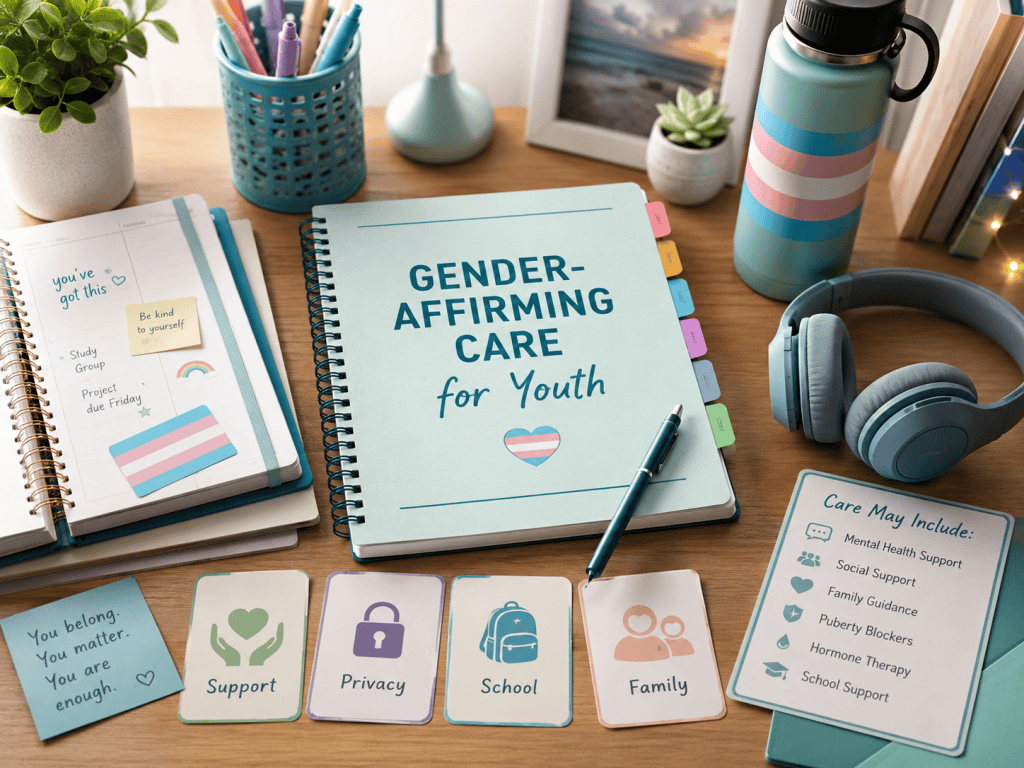
Gender-Affirming Care:
For Youth
Youth gender-affirming care is often discussed in a political climate shaped by fear, misinformation, and ideological efforts to restrict access. This page starts from a clear evidence-informed premise: gender-diverse young people deserve careful, individualized, developmentally appropriate support, and gender-affirming care remains the best-practice framework endorsed by major medical and mental health organizations. Care decisions should be made with qualified clinicians, young people, and their families or caregivers — not by political talking points. This guide explains what youth care may include, how decisions are made, and how families can ask informed questions while protecting a young person’s safety, dignity, and well-being.
On This Page
A Note on Youth Care, Evidence, and Access
Youth gender-affirming care is not a single intervention or one-size-fits-all pathway. It can include social support, mental health care, family guidance, school support, privacy and safety planning, and — for some adolescents — carefully evaluated medical care. Decisions should be individualized, developmentally appropriate, and made with qualified clinicians, young people, and their families or caregivers whenever possible.
Access to this care does not exist in a neutral landscape. For many individuals and families, care is shaped not only by personal need and medical guidance, but also by changing laws, insurance barriers, provider availability, and a political climate heavily influenced by disinformation and anti-trans bias. Clear, grounded information can help families ask better questions, understand the difference between evidence-based care and political talking points, and protect a young person’s safety, dignity, and well-being.

What Youth Care May Include
Youth gender-affirming care is not one singular pathway. Depending on age, developmental stage, individual needs, family context, and available providers, care may include social support, mental health support, family guidance, education, medical evaluation, and other forms of affirming guidance. Not every young person will need or want the same kinds of care, and care decisions are typically made with attention to the whole person rather than a one-size-fits-all model.
Youth care may include:
Social support: respecting a young person’s name, pronouns, clothing, hairstyle, or other forms of gender expression.
Family and caregiver guidance: helping parents, caregivers, and family members ask informed questions, reduce conflict, and support a young person’s safety and well-being.
School and community support: helping youth navigate school records, privacy, bullying, restroom access, activities, peer relationships, and trusted adults.
Mental health support: providing space to explore distress, resilience, family stress, anxiety, depression, trauma, or other concerns without treating gender diversity itself as a disorder.
Medical evaluation: meeting with qualified clinicians to discuss development, health history, goals, risks, benefits, alternatives, and timing.
Fertility-related counseling: for some young people and families, care may include discussion of fertility preservation, future family-building options, reproductive health, and how puberty-related or hormone-related care may affect fertility. These conversations should be age-appropriate, clinically accurate, emotionally sensitive, and guided by qualified professionals.
Puberty-related care: for some adolescents, this may include discussion of puberty blockers after puberty has begun, when clinically appropriate.
Hormone-related care: for some older adolescents, this may include discussion of gender-affirming hormones, with careful clinical assessment and informed consent processes.
Surgical care: for some older adolescents, surgical care may be discussed when it is developmentally appropriate, clinically indicated, legally available, and supported by careful assessment, informed consent or assent processes, and family/caregiver involvement where required. Surgical care for minors is uncommon, but it should not be misrepresented as categorically inappropriate when qualified clinicians and the young person determine that it is medically necessary, with family or caregiver involvement where required.
How Care Decisions Are Made
Care decisions involving young people are typically made with attention to age, development, wellbeing, family context, informed consent processes, and the guidance of qualified professionals. Rather than following a single universal pathway, youth care is generally approached through ongoing assessment, conversation, and support that takes the young person’s needs and circumstances seriously.
Common Misunderstandings
Public conversations about youth gender-affirming care are often shaped by both misinformation—inaccurate claims that may be repeated without full understanding—and disinformation— politically or ideologically motivated distortion designed to create fear/confusion/opposition to care.
These narratives often rely on oversimplified, binary-centric framing that can make it harder for individuals and families to find clear, trustworthy information.
Misunderstanding: Youth gender-affirming care is one single thing.
Youth gender-affirming care is not one intervention or one fixed pathway. It may include social support, family guidance, school support, mental health care, privacy and safety planning, medical evaluation, puberty-related care, hormone-related care, or, in uncommon cases involving older adolescents, surgical care.
Misunderstanding: Supporting a young person means rushing them into medical treatment.
Support can begin with listening, reducing feelings of shame, using a young person’s chosen name or pronouns, helping them stay safe, and connecting them with qualified gender-affirming professionals.
Medical care, when considered, should involve careful assessment, informed decision-making, and attention to the young person’s age, development, needs, and circumstances.
Misunderstanding: Gender diversity itself is a disorder.
Gender diversity is not itself a mental illness. Some transgender and gender-diverse young people may experience gender dysphoria, which refers to clinically significant distress that can occur when a person’s gender identity does not align with aspects of their body, assigned sex, or how they are recognized by others. Young people may also experience anxiety, depression, family conflict, discrimination, or safety concerns, especially when they lack support or face hostility.
Ethical care should address distress and support well-being without treating a young person’s identity or expression as something to be corrected or erased.
Misunderstanding: Families are excluded from care decisions.
For minors, families and caregivers are often central to care planning, support, safety, and consent processes. The exact role may depend on age, law, clinical setting, safety concerns, and family circumstances, but responsible youth care does not treat young people as isolated from the adults responsible for their care.
Misunderstanding: Political controversy means the care is experimental or unsupported.
Political controversy is not the same as medical uncertainty. Major medical and mental health organizations continue to support access to careful, individualized, evidence-informed gender-affirming care for transgender and gender-diverse young people.
Disagreement in public debate should not be confused with the work of qualified clinicians using established standards of care.
Misunderstanding: Retransition means gender-affirming care has failed.
Some young people may change how they understand, describe, or express their gender over time. A young person may retransition, detransition, shift from one gender identity to another, move from a binary identity to a nonbinary identity, return to a previous identity, or change some parts of a social, legal, or medical transition. These experiences should be met with care, honesty, and support rather than shame or political exploitation.
Retransition does not automatically mean that earlier support was harmful or that gender-affirming care as a whole is invalid. It may reflect evolving self-understanding, developmental change, safety concerns, family pressure, school or community hostility, medical needs, or practical barriers.
Ethical care should support young people in asking questions, reconsidering decisions when needed, and receiving appropriate care without losing dignity, trust, or access to support.
Sources & Medical Consensus
The sources below are included because youth gender-affirming care is often misrepresented in political and media debates. These long-established, mainstream medical and mental health organizations are not identical in every recommendation or clinical emphasis, but they broadly support access to careful, individualized, evidence-informed care for transgender and gender-diverse young people.
American Academy of Pediatrics—reaffirmed its policy supporting comprehensive care and support for transgender and gender-diverse youth.
American Academy of Child & Adolescent Psychiatry—supports multidisciplinary, evidence-based, trauma-informed care and individualized treatment planning with clinicians, youth, and families.
American Medical Association—opposes legislative interference in medically necessary gender-affirming care and supports evidence-based coverage.
Endocrine Society—maintains clinical-practice guideline resources for gender dysphoria/gender incongruence, including adolescent-related recommendations.
American Society for Reproductive Medicine—states that ovarian tissue cryopreservation is no longer considered experimental for appropriate medical indications and can be used for prepubertal patients or when ovarian stimulation/oocyte retrieval is not feasible.
Read ASRM’s Ethics Committee Opinion on access to fertility services for transgender and nonbinary persons.
Retransition and the Olson Study—in a longitudinal study following socially transitioned youth, Olson et al. found that 7.3% had retransitioned at least once over about five years, while most continued to identify as binary transgender and a smaller number identified as nonbinary or cisgender at follow-up. This study is useful for understanding gender trajectories after social transition, but it should not be misread as a general measure of regret about medical care.
Current Access Conditions
Access to gender-affirming care for young people can change even when the care itself remains legal under state law. Federal funding restrictions, healthcare-system decisions, insurer policies, investigations, subpoenas, and ongoing litigation can all affect whether services are practically available.
Beginning October 13, 2026, federal Medicaid and CHIP funds generally may not be used for specified gender-affirming medical interventions for minors under a new federal rule. This is a funding restriction rather than a nationwide ban on care, but it may substantially affect access for young people who rely on Medicaid or CHIP.
State-law restrictions are also continuing to change through litigation. In September 2026, the North Dakota Supreme Court upheld challenged provisions of the state’s youth gender-affirming-care restrictions against the constitutional claims before it. The ruling did not establish a nationwide rule and did not resolve the medical appropriateness of gender-affirming care generally; it addressed the validity of North Dakota’s law under the specific state constitutional claims presented.
Because legal and coverage rules are changing quickly, families should verify current requirements before assuming that a particular service, provider, or source of coverage remains available.