


When Clinical Guidance Becomes “Gender Ideology”
An Evidence Audit of the HHS Report on Gender Affirmation, Authoritarianism, and Political Violence
By Jenn Burleton
Emerging Analysis · August 2026
Last reviewed: October 1, 2026
About this analysis
In August 2026, the U.S. Department of Health and Human Services published a commissioned report examining statistical associations among agreement with selected positions drawn from gender-affirming clinical guidance, Left-wing authoritarianism, and judgments about the justification of six specified acts of political violence. HHS publicly presents the findings as evidence linking support for “gender-affirming” norms with authoritarian attitudes and greater justification of political violence. The report acknowledges that its cross-sectional design cannot determine causality and that it did not measure violent behavior or intent.
Burleton Education examines four questions throughout this analysis:
- What did the study measure?
- What did it find?
- What do the authors infer from those findings?
- How does HHS represent those findings to the public?
On This Page
Executive Summary
The survey reports statistically significant associations. In a preregistered cross-sectional sample of 1,208 U.S. adults, stronger endorsement of the researchers’ newly created Clinical Gender Affirmation Scale (CGAS) was associated with higher scores on a previously published measure of left-wing authoritarianism. Both measures were also associated with higher ratings of how justified respondents considered six specified acts of political violence. Those associations were consistently stronger for left-wing authoritarianism than for CGAS.
The findings are narrower than some of the report’s interpretive language suggests. The survey did not measure whether participants had committed political violence, intended to commit it, or belonged to violent movements. HHS acknowledges this limitation. The cross-sectional design also cannot establish whether gender-affirming beliefs contribute to authoritarian attitudes, whether authoritarian attitudes contribute to those beliefs, or whether another factor contributes to both.
The construction and interpretation of the CGAS are therefore central to evaluating the report. Its five items reformulate selected positions that the researchers describe as drawn from professional clinical guidance. Agreement with those items is subsequently characterized as “gender ideology” and interpreted in the report’s conclusion as potentially functioning as an “ideological accelerant” that supplies authoritarian psychology with enemies, urgency, and moral permission for force. That proposed mechanism is an interpretation of the observed associations—not something the survey directly tested.
The report does not establish that CGAS is associated with political-violence justification independently of left-wing authoritarianism. Its reported violence models examine CGAS and political identity together, and LWA and political identity together, but do not include CGAS and LWA in the same model. The findings therefore cannot determine whether CGAS explains additional variation in violence justification after accounting for the authoritarianism measure with which it is already substantially correlated.
This evidence audit examines what the study measured, what it found, what the authors infer from those findings, and how HHS publicly frames those findings through the broader political category of “radical gender ideology.”
What HHS Says
HHS introduces the commissioned research with a broad public claim. Its August 26 release is titled “HHS Releases Study Finding Individuals Who Associate with Left-Wing Authoritarian Beliefs and Radical Gender Ideology Are More Likely to Justify Political Violence.” Its opening paragraph similarly states that people who believed in what HHS calls “radical gender ideology” were more likely to hold left-wing authoritarian beliefs and to believe political violence is justified.
The agency then describes the findings more specifically. HHS states that stronger endorsement of what it calls “so-called ‘gender-affirming’ clinical positions” was substantially associated with higher scores on the left-wing authoritarianism measure, including after researchers accounted for political identity and age. It also states that both the gender-affirmation measure and the authoritarianism measure were associated with greater justification of political violence across six scenarios. HHS acknowledges that the associations involving gender-affirming beliefs were generally weaker than those involving left-wing authoritarianism.
HHS does more than summarize the statistical findings. The release adopts the report authors’ interpretive framework, describing the beliefs measured by the Clinical Gender Affirmation Scale as “radical gender ideology” and “sex-rejecting” positions. It presents the authors’ proposal that these beliefs may provide a framework through which authoritarian tendencies become directed toward perceived threats, outgroups, and institutional action. It also repeats their proposal that clinical and professional institutions may lend authority to that framework, potentially supplying people already predisposed toward authoritarianism with moral justification for coercive or punitive action.
The release nevertheless acknowledges two important limitations. It states that the survey cannot determine whether belief in what HHS calls “radical gender ideology” contributes to authoritarian attitudes, whether the relationship operates in the opposite direction, or whether another factor contributes to both. It also acknowledges that the study measured respondents’ judgments about the justification of six specified acts of political violence—not whether respondents had committed or intended to commit political violence.
The resulting tension is not that HHS entirely omits the study’s limitations, but that its headline and opening language encourage a broader interpretation than those limitations permit. The release publicly links “radical gender ideology,” authoritarianism, and political violence before later clarifying that the research establishes neither causal direction nor violent behavior or intent.
The Terminology Has a Documented Political Provenance
The phrase “sex-rejecting procedures” was developed and promoted as an explicitly evaluative replacement for “gender-affirming care.” Its proponents argued that the existing clinical terminology reflected “gender ideology” and that the replacement phrase would better communicate their interpretation of the interventions.
In April 2025, scholars at the conservative Ethics & Public Policy Center (EPPC) urged HHS to replace the administration’s then-preferred term, “sex-trait modification,” with “sex-rejecting procedures.” The following month, EPPC published a dedicated proposal arguing that “gender-affirming care” should be abandoned and explaining why its preferred phrase would convey what it described as the “unnatural and disruptive nature” of the targeted procedures.
The effort extended beyond publication. In August 2025, the same EPPC scholars met with officials in the Executive Office of the President and HHS and urged federal regulators to use the phrase in forthcoming CMS rules. EPPC later reported that its scholars had advocated for the terminology with White House staff, circulated a supporting coalition letter to approximately 250 administration and congressional officials, and regarded the administration’s subsequent adoption of the phrase as a policy success.
By November 2025, HHS was using “sex-rejecting procedures” in the title and body of a federal report on pediatric gender dysphoria. The terminology later appeared in regulatory actions, including an August 2026 final rule prohibiting the use of federal Medicaid and CHIP funding for procedures placed within that category for children and youth.

The phrase therefore carries an argument inside the label. It characterizes the interventions as rejecting biological sex rather than describing them through the clinical framework of treating gender dysphoria or gender incongruence. The documentary record shows that HHS’s terminology was not simply an interchangeable medical description: it followed a documented advocacy campaign to replace the existing language with a politically and morally evaluative alternative.
Sources Supporting This Terminology Provenance:
- Ethics & Public Policy Center, EPPC Scholars Submit Comment Supporting HHS’s Proposed Removal of Sex-Rejecting Procedures from Essential Health Benefits (Apr. 11, 2025), documenting EPPC’s recommendation that HHS replace “sex-trait modification” with “sex-rejecting procedures.”
- Ethics & Public Policy Center, Terminology and Definition: Replacing “Gender-Affirming Care” with “Sex-Rejecting Procedures” (May 9, 2025), explicitly proposing the terminology as a replacement for “gender-affirming care” and arguing that the latter reflects “gender ideology.”
- Ethics & Public Policy Center, EPPC Scholars Urge Government Officials to Replace the Term “Gender-Affirming Care” with “Sex-Rejecting Procedures” (Aug. 28, 2025), documenting a meeting with Executive Office of the President and HHS officials in which EPPC urged adoption of the term in forthcoming CMS rules.
- Ethics & Public Policy Center, 2025 Annual Report, describing adoption of “sex-rejecting procedures” by the Trump administration as an EPPC policy victory and explicitly connecting the effort to the political importance of language.
- U.S. Department of Health and Human Services, HHS Releases Peer-Reviewed Report Discrediting Pediatric Sex-Rejecting Procedures (Nov. 19, 2025), documenting federal adoption of the terminology.
- Centers for Medicare & Medicaid Services, Final Rule: Prohibition on Federal Medicaid and CHIP Funding for Sex Rejecting Procedures Furnished to Children and Youth (Aug. 11, 2026), documenting the terminology’s use in the final funding restriction.
What the Research Actually Measured
Before evaluating the report’s conclusions, it is important to distinguish the theoretical constructs and labels used by the authors from the questions participants actually answered and the variables produced from those responses.
The researchers administered a preregistered, cross-sectional online questionnaire to a sample of U.S. adults recruited through CloudResearch Connect. The questionnaire included several separate measures: the researchers’ newly created Clinical Gender Affirmation Scale, a previously published measure of left-wing authoritarianism, additional items concerning gender identity and perceived threats to transgender people, and ratings concerning the justification of political violence and support for anti-democratic behavior. Not all variables collected in the questionnaire were analyzed in the present report.
Who Conducted the Research?
The report lists Ohad Fedida and Danit Finkelstein of Rutgers University; Colin Wright, Ph.D., of the Manhattan Institute; Lee Jussim, Ph.D., of Rutgers University; and Joel Finkelstein, Ph.D., of the Network Contagion Research Institute (NCRI). Jussim and Joel Finkelstein are identified as co-principal investigators.
Several members of the team had worked together before this project. Rutgers’ Social Perception Lab identifies Fedida and Danit Finkelstein as researchers studying political extremism under Jussim. Jussim states that he began working with NCRI in 2020 and has since coauthored reports and academic research with its investigators. Danit Finkelstein, Jussim, and Joel Finkelstein have also appeared together as authors on research concerning online information and political attitudes.
Colin Wright brings a different—and particularly relevant—policy background. Wright is an evolutionary biologist and fellow at the Manhattan Institute, a conservative public-policy think tank. His work focuses extensively on biological sex, transgender policy, and what he and the institute describe as “gender identity ideology.”
Wright’s relationship to the current federal policy framework extends beyond general ideological agreement. The Manhattan Institute’s 2025 President’s Update states that a “crucial definition” included in President Trump’s January 20, 2025 executive order was written by Wright in consultation with other evolutionary biologists. That order established sex-based definitions for federal policy and directed the Secretary of Health and Human Services to issue guidance expanding upon them.
These connections do not establish that any author or institution dictated the research methods or findings. They do establish that several researchers had previously collaborated and that one author had participated directly in shaping the federal sex-policy framework HHS was subsequently directed to implement. That provenance is relevant context, but the validity of the report must still be assessed through its measures, analyses, and conclusions.
The Research Was Commissioned Within an Existing Policy Framework
The federal executive branch had adopted an explicit policy against what the administration calls “gender ideology” before HHS released this research in August 2026. President Trump’s January 2025 executive order established sex-based definitions for use across the executive branch, directed agencies to eliminate policies that it characterized as promoting “gender ideology,” and instructed HHS to issue guidance expanding upon those definitions.
HHS subsequently designated “Combat gender ideology and protect children” as an explicit departmental priority. Its published priorities state that HHS programs should reflect the department’s definition of biological sex and that, where legally permissible, it will deprioritize programs engaging in practices inconsistent with that policy. OPA funding notices also require funded activities to align with the priorities of the Office of the Assistant Secretary for Health.
HHS had already begun implementing this framework through funding decisions. In August 2025, the department directed 46 states and territories to remove what it called “gender ideology” from federally funded Personal Responsibility Education Program materials. HHS warned that noncompliance could result in withholding, suspension, or termination of federal funding and had already terminated California’s PREP grant.
Against this background, HHS commissioned and published Where the Clinic Meets the Movement. The report is hosted by the Office of Population Affairs, an office within the Office of the Assistant Secretary for Health, and HHS describes the research as commissioned. Assistant Secretary for Health Brian Christine supplied the department’s principal public interpretation, asking what happens when “ideology is given the authority of medicine” and describing the measured beliefs as “sex-rejecting clinical beliefs.” HHS also stated that it would continue investigating these relationships.
This chronology establishes policy context, but it does not establish that HHS predetermined the statistical findings or instructed the researchers to reach a particular conclusion. The available public record does not reveal the commissioning agreement, statement of work, investigator-selection process, or communications surrounding development of the survey. Burleton Education has requested those records through the Freedom of Information Act.
What the chronology does establish is narrower:
an agency already committed to combating “gender ideology” commissioned research that converted agreement with selected gender-affirming positions into a numerical measure, examined its relationship with left-wing authoritarianism and judgments about political violence, and publicly interpreted the resulting associations through the agency’s pre-existing policy framework.
Participants and Study Design
Researchers recruited 1,305 U.S. adults through CloudResearch Connect, an online platform through which registered participants voluntarily enroll in paid research. After excluding 97 respondents for failed attention checks, bot-detection failures, completion in under six minutes, duplicate IDs, or incomplete responses, the final analytic sample included 1,208 adults. The researchers preregistered the project before beginning data collection.
The final sample had a mean age of 45.1 years. The report identifies 51.2% of participants as female, 47.8% as male, and 1.1% as transgender-identifying or gender-nonconforming. Politically, 55.0% identified as or leaned Democratic, 27.2% identified as or leaned Republican, 15.1% were independents with no partisan lean, and 2.7% reported no affiliation or another affiliation.
Although the report describes the participants as a “national sample,” recruitment through an opt-in online participant platform does not by itself establish that the sample was nationally representative or probability-based. The report does not identify population weights intended to make the sample representative of U.S. adults.
This was a cross-sectional survey: participants completed the measures at a single point in time. It can identify relationships among responses within the sample, but it cannot establish temporal sequence or causal direction. Those implications are examined in greater detail below.
What Participants Were Asked
Participants did not answer broad questions asking whether they endorsed “gender ideology,” were authoritarian, or supported political violence in general. Instead, they completed several separate sets of survey items. These included the 13-item Brief Left-Wing Authoritarianism Scale; the researchers’ newly created five-item Clinical Gender Affirmation Scale (CGAS); additional questions concerning gender identity and perceived threats to transgender people; a question about the perceived likelihood that a “trans genocide” was occurring; justification ratings for six specified acts of political violence; and questions concerning selected anti-democratic behaviors. The order in which participants received the scales was randomized.
The researchers converted responses to these separate measures into scores or outcome variables and then examined their statistical relationships. Participants were not presented with a single construct linking gender-affirming clinical guidance, authoritarianism, and political violence. That linkage was created analytically through comparisons among their responses to separate sets of questions. Some measures collected in the questionnaire—including several anti-democratic outcomes—were not analyzed fully in the present report.
Left-Wing Authoritarianism
The researchers operationalized left-wing authoritarianism using the 13-item Brief Left-Wing Authoritarianism Scale, developed by Thomas Costello and Christopher Patrick as an abbreviated version of the earlier 39-item Left-Wing Authoritarianism Index. The HHS report describes left-wing authoritarianism as the construct “at the center” of its research.
The instrument is intended to assess authoritarian attitudes expressed through Left-coded political content, including support for coercive institutional control, hostility toward perceived ideological opponents, and punitive action against groups or institutions viewed as maintaining unjust hierarchies. It is not intended merely as a measure of liberal or Democratic political identification.
The 13-item measure contains three correlated dimensions:
- Anti-Hierarchical Aggression
- Top-Down Censorship
- Anti-Conventionalism
Throughout this analysis, references to participants’ “LWA scores” mean scores produced from responses to this particular instrument—not a direct observation or clinical classification of an underlying authoritarian personality.
Who developed the scale?
Thomas H. Costello is a psychologist and computational social scientist at Carnegie Mellon University whose research includes political belief, authoritarianism, polarization, conspiracy beliefs, and belief change. Christopher J. Patrick is a Distinguished Research Professor and Director of Clinical Training at Florida State University whose research includes personality, psychopathy, antisocial behavior, psychological assessment, and quantitative measurement. Burleton Education identified no documented partisan affiliation for either researcher in the sources reviewed; their personal political views should not be inferred from the subjects they study.
What the items actually ask
Participants rated their agreement with 13 statements on a seven-point scale ranging from “strongly disagree” to “strongly agree.” The items do not ask about authoritarianism in the abstract; they present attitudes and proposed actions framed through Left-coded political content.
Examples include stripping wealth and status from the rich, replacing the established political order “by any means necessary,” allowing the government to shut down certain right-wing websites, and prioritizing the elimination of inequality over free-speech protections. Other items characterize all political conservatives as foolish or anyone who opposes same-sex marriage as homophobic. One item describes enjoying watching perceived oppressors suffer violence.
Responses were combined to produce an overall LWA score, with higher scores interpreted as indicating stronger left-wing authoritarian tendencies. Several items combine coercive, punitive, or censorious attitudes with explicitly Left-coded targets and values. Interpreting the resulting score therefore requires attention to both components: the authoritarian form of the attitudes and the political content through which that form is expressed.
What validation established—and what it did not
Costello and Patrick developed the 13-item measure from the 39-item Left-Wing Authoritarianism Index previously created by Costello and colleagues. The original research developed and evaluated that broader index across six samples totaling 7,258 participants.
To create the abbreviated versions, Costello and Patrick used a demographically representative U.S. sample of 834 adults and then conducted additional validation tests in a second community sample of 477. The 13-item version closely resembled the longer index in internal consistency, score distribution, and patterns of association with 14 external criteria, including need for chaos, political violence, anomia (a psychological sense of alienation, normlessness, and distrust in social rules), and low institutional trust.
Subsequent research found that the 13-item measure’s structure was sufficiently stable across sex, age, and education to permit comparisons among those groups in the sample studied. That finding supports the instrument’s structural performance, but it does not establish that the measure will function identically across every population, culture, or political context.
This evidence supports treating the 13-item Brief LWA Scale as a previously developed and psychometrically tested instrument. It does not resolve the continuing debate over what the instrument measures. Critics argue that some LWA scales combine authoritarian attitudes with ordinary progressive ideological content, making the two components difficult to separate. Defenders respond that LWA scores remain associated with authoritarian characteristics after accounting for political ideology and when analyses are restricted to politically liberal participants.
The appropriate conclusion is therefore neither that the measure is unvalidated nor that its interpretation is scientifically settled. It has substantial published psychometric support, while the conceptual meaning and political comparability of its scores remain disputed.
View the 13 Brief Left-Wing Authoritarianism Scale Items (paraphrased)
The items below paraphrase the 13 statements reproduced in Appendix B of the HHS report. The grouping follows the report’s assignment of each item to one of the scale’s three dimensions. These paraphrases are provided for readability; readers should consult the published measure for the exact wording.
- Wealthy people should be stripped of their property and social status.
- Society would be better if wealthy people occupied the bottom of the social hierarchy.
- Respondents would enjoy seeing people they regard as oppressors suffer the violence those oppressors had inflicted on others.
- The existing social and political order should be replaced by whatever means are necessary.
- Anyone who opposes same-sex marriage should be regarded as homophobic.
- Concern about terrorism should focus primarily on extremists on the political right.
- Traditional or “old-fashioned” values should be abolished.
- Political conservatives are foolish.
- Classroom discussions should protect students from disturbing ideas.
- University authorities are justified in prohibiting hateful speech on campus.
- Successful workplaces should protect employees from criticism.
- Government should be permitted to shut down right-wing websites or blogs that promote hateful or extreme positions.
- Eliminating inequality should take priority over protecting free-speech rights.
Note: The grouping above follows Appendix B of the HHS report. The original LWA-13 validation research presents a more complex measurement model, discussed below under “HHS Simplifies the Scale’s Factor Structure.”
Response format: Participants indicated agreement or disagreement on a seven-point scale.
Higher aggregate scores were interpreted as stronger left-wing authoritarian tendencies.
Why the 13-Item Version Matters
The 13-item Brief Left-Wing Authoritarianism Scale is the shorter of two abbreviated forms—25 and 13 items—derived from the original 39-item Left-Wing Authoritarianism Index. In their initial validation, Costello and Patrick found that both abbreviated forms closely approximated the longer measure’s overall psychometric properties and relationships with external criteria.
The authors nevertheless advised that the full instrument may be preferable when left-wing authoritarianism is itself a principal focus of the research, and that the 25-item version may be better suited to analyses requiring more reliable distinctions among the measure’s dimensions. That guidance is relevant here: HHS describes left-wing authoritarianism as a construct “at the center” of its research but administers the shorter, 13-item form.
This choice does not invalidate the analysis. It does, however, mean that the results are best interpreted as associations involving a brief overall measure of left-wing authoritarianism—not as a detailed assessment of anti-hierarchical aggression, anti-conventionalism, and top-down censorship as distinct dimensions.
Appendix B Simplifies the Scale’s Factor Structure
HHS Appendix B assigns each of the 13 items to one of three subscale headings: Anti-Hierarchical Aggression, Anti-Conventionalism, or Top-Down Censorship. The published LWA-13 measurement model is more complicated. Costello and Patrick report that a handful of retained items serve as indicators of more than one factor, reflecting both general left-wing authoritarianism and variance associated with different dimensions.
The authors also found some loss of discriminant validity among the abbreviated subscales, although the differences from the full instrument were modest. They nevertheless concluded that, overall, the LWA-13 and LWA-25 closely reproduced the performance of the original index.
HHS does not report or interpret separate scores for the three dimensions; its analyses use an overall LWA score. Accordingly, Appendix B’s categories should not be mistaken for a complete representation of the published measurement model, but this simplification does not by itself invalidate the report’s total-score analyses. It would become more consequential if the three dimensions were analyzed or interpreted as independently measured constructs.
HHS Does Not Report Sample-Specific Reliability for the LWA-13
For its newly developed Clinical Gender Affirmation Scale, HHS reports an internal-consistency estimate (Cronbach’s α = .95), mean, and standard deviation. For the LWA-13, the report identifies the instrument but provides neither a sample-specific internal-consistency estimate nor overall score descriptives.
Reliability is not a fixed property that automatically transfers from one study to another. The LWA-13’s previous validation supports its general use, but it does not substitute for reporting how consistently its items functioned in the present sample. Given the central role assigned to LWA, an estimate such as Cronbach’s alpha or McDonald’s omega would have been informative.
This omission does not establish that the LWA-13 was unreliable, nor does it by itself negate the reported associations. It prevents readers from evaluating the measure’s internal consistency and overall score distribution among these 1,208 respondents.
The LWA-13 Includes Violent and Coercive Content
Two LWA-13 items are particularly relevant to HHS’s later analyses of political violence. One explicitly asks whether respondents would enjoy seeing perceived oppressors suffer violence. Another endorses replacing the established order “by any means necessary.” Agreement with these statements contributes to the overall LWA score.
The report’s political-violence outcomes are separate survey questions, so the relationship is neither mathematically circular nor a part–whole correlation. There is, however, conceptual overlap: a predictor incorporating violent or revolutionary-coercive sentiment is being related to willingness to justify other specified acts of political violence.
This association is also consistent with the scale’s original validation, in which political violence was one of the external criteria used to evaluate the abbreviated LWA measures. HHS’s results therefore show that respondents scoring higher on this broader bundle of authoritarian, censorious, coercive, and partly violent attitudes were more likely to justify the particular violent acts presented in its survey. They do not represent the unexpected discovery that a wholly nonviolent psychological disposition is associated with political violence.
The overlap does not invalidate the correlations, but it limits their novelty and should inform their substantive interpretation.
What the LWA Results Can—and Cannot—Show
The HHS findings support a limited but meaningful conclusion: within this sample, respondents with higher LWA-13 scores also tended to endorse CGAS statements more strongly and to express greater justification for each of the six specified acts of political violence. These associations remained statistically significant after political identity was included in the reported models—and, in the CGAS model, after age was included as well.
The findings do not establish that left-wing authoritarianism caused either response, that participants possess a clinically identifiable authoritarian personality, or that the scale’s three dimensions operated independently in this sample. Nor can an opt-in, nonprobability survey establish the prevalence of left-wing authoritarianism in the U.S. population. The results concern associations among scores on particular self-report measures collected from these respondents at one point in time.
Clinical Gender Affirmation Scale (CGAS)
The HHS report introduced a new five-item measure that its authors named the Clinical Gender Affirmation Scale (CGAS). Unlike the LWA-13, the CGAS was developed specifically for this study rather than adopted from a previously established instrument.
Participants rated five statements addressing the perceived psychological consequences of non-affirmation, support for transgender identity expression, use of chosen names and preferred pronouns, and parental support for children’s transgender exploration. Responses were combined into an overall score, with higher scores representing stronger agreement with the five statements.
Because the CGAS is newly constructed, the interpretation of every analysis involving it depends on the content of its items, how they were derived from the cited guidance, whether they measure a coherent construct, and whether the scale’s name accurately characterizes that construct. The following sections examine each of those questions.
What the CGAS Actually Asked
The HHS report says the Clinical Gender Affirmation Scale was created specifically for this research to measure endorsement of what the authors describe as the “official clinical consensus positions” of the American Psychological Association, American Psychiatric Association, World Professional Association for Transgender Health, and American Academy of Pediatrics. The scale contains just five items, each rated on a seven-point agreement scale.
Participants were asked to rate their agreement with the following statements:
- Failure to affirm a transgender person’s gender identity increases the risk of serious psychological distress.
- People should be supported in expressing their transgender identity.
- Using the name a person chooses as part of their gender transition is a necessary form of support.
- Using a transgender person’s preferred pronouns (e.g., he/him, she/her, they/them) is a necessary form of support.
- Parents should support their children’s transgender exploration.
These five responses form the CGAS score. Higher scores directly represent stronger agreement with this particular bundle of propositions. Interpreting that score as a measure of the broader construct “gender ideology,” however, requires construct-validity evidence beyond showing that the five responses are internally consistent.
CGAS Does Not Measure Medical Treatment
HHS describes the CGAS as measuring “official clinical consensus positions” concerning transgender people and medical interventions. Yet none of its five items asks respondents to evaluate or endorse a medical intervention.
The items address psychological distress associated with nonaffirmation, support for transgender identity expression, chosen names, preferred pronouns, and parental support for gender exploration. They do not ask about puberty suppression, hormone therapy, surgery, diagnostic assessment, treatment eligibility, informed consent, treatment risks, or clinical outcomes.
Accordingly, CGAS scores cannot by themselves demonstrate support for gender-affirming medical treatment. They measure agreement with five predominantly social and interpersonal propositions derived from clinical guidance—not respondents’ views about the medical interventions often central to public debates over gender-affirming care.
How Faithfully Do the CGAS Items Represent the Source Guidance?
HHS states that the five CGAS items were “derived directly” from clinical guidance, and Table 1 identifies passages associated with each item. The questionnaire statements are not direct quotations, however. They synthesize and sometimes narrow or strengthen language appearing in the displayed source excerpts.
This distinction is relevant to the scale’s content validity. Establishing that an item originated in professional guidance does not, by itself, establish that its reformulation preserves the guidance’s meaning, scope, and degree of certainty.
Item 1 — Psychological distress
CGAS item: “Failure to affirm a transgender person’s gender identity increases the risk of serious psychological distress.”
The report cites passages about stigma and discrimination, family and societal rejection, minority stress associated with rejection or nonaffirmation, and lower distress among supported youth. The American Psychiatric Association currently states that family and societal rejection of a person’s gender identity are strong predictors of mental-health difficulties.
The CGAS item is therefore grounded in the cited guidance, but it compresses several different concepts—stigma, discrimination, rejection, nonaffirmation, and support—into the single phrase “failure to affirm.” It also recasts source passages concerning associations, predictors, rejection, and supportive environments as a single generalized statement that failure to affirm “increases the risk” of serious distress.
That is not necessarily an unreasonable synthesis, but it is not equivalent to reproducing the source language directly.
Item 2 — Supporting gender expression
CGAS item: “People should be supported in expressing their transgender identity.”
The cited source passages are fairly close in substance. They discuss respecting and supporting authentic articulation of gender identity and expression, open-ended exploration, care that affirms gender identities and expressions, and allowing children to explore gender. The American Psychological Association’s own description of its guidelines says psychologists should provide acceptance, support, and understanding without making assumptions about clients’ gender identities or expressions.
This item appears to be one of the more faithful summaries of the cited guidance.
Item 3 — Chosen names
CGAS item: “Using the name a person chooses as part of their gender transition is a necessary form of support.”
The cited documents discuss nonuse of a preferred name as a form of discrimination, social affirmation that may include adopting a name, staff addressing people by chosen names and pronouns, and use of a patient-asserted name.
The significant addition is “necessary.” The excerpts reproduced by HHS support the use of chosen or patient-asserted names, but they do not state that doing so is categorically a “necessary form of support.”
So this item appears to move from a recommendation or description of affirming practice to a stronger normative proposition.
Item 4 — Pronouns
CGAS item: “Using a transgender person’s preferred pronouns is a necessary form of support.”
The same issue appears here. The source material supports use of a person’s pronouns and describes incorrect pronoun use as potentially reinforcing the gender binary or as inconsistent with affirming practice.
Again, “necessary form of support” is HHS’s questionnaire formulation, not language reproduced in the source excerpts displayed in its table.
Item 5 — Parental support for exploration
CGAS item: “Parents should support their children’s transgender exploration.”
The sources cited by HHS discuss providing a safe environment to explore gender identity, allowing children freedom in gender-identity development, creating supportive family environments, supporting children in continuing to explore their gender, and links between supportive parental involvement and better health outcomes.
The item is therefore grounded in recognizable themes from the cited guidance. But “transgender exploration” is a narrower and more specific formulation than much of the source language, which often refers more broadly to gender identity development or exploration. It can imply that the child is already engaged in specifically transgender exploration rather than exploring gender more generally.
All five items have identifiable roots in the cited professional guidance, but they are not verbatim reproductions of it. Some consolidate distinct concepts under “affirmation,” add normative language such as “necessary,” or narrow broader discussion of gender exploration to specifically “transgender exploration.” The CGAS therefore measures agreement with HHS’s reformulated propositions—not direct agreement with the source documents themselves. That distinction matters when the resulting score is subsequently characterized as measuring “clinical gender affirmation” or, more broadly, “gender ideology.”
What Does High Internal Consistency Establish?
The five CGAS items address several kinds of propositions: psychological risk, social support, chosen names, preferred pronouns, and parental responses to gender exploration. HHS combines the responses into a single score labeled “clinical gender affirmation” and reports very high internal consistency: Cronbach’s α = .95. On the seven-point response scale, the reported CGAS mean was 4.87 (SD = 1.93).
Cronbach’s alpha describes how strongly a set of item responses covaries. The reported value shows that responses to these five items were highly internally consistent in this sample. It does not mean that the items are interchangeable or establish that they measure only one underlying construct.
Alpha alone cannot establish unidimensionality, construct validity, discriminant validity, or the accuracy of a scale’s name. A very high value can also reflect closely overlapping items or a shared response to their common political, moral, or social framing.
HHS does not report a factor analysis or comparisons with alternative measures designed to determine whether the five items measure a distinct construct rather than a broader attitude or ideological orientation. The reported alpha therefore supports the narrower conclusion that the five responses form a strongly internally consistent composite; it does not establish CGAS as a validated measure of a distinct construct called “clinical gender affirmation.”
The measure was introduced and analyzed in the same sample. No replication in an independent sample is reported.
The Name Implies More Clinical Specificity Than the Items Measure
The name Clinical Gender Affirmation Scale may suggest that the instrument measures a specifically clinical construct. Yet CGAS was administered to members of the general public, not clinicians, and its items do not assess clinical decision-making, diagnostic reasoning, treatment practices, adherence to clinical protocols, or patient outcomes.
“Clinical” describes the provenance of the selected source material rather than the respondents, behaviors, or decisions being measured. Deriving propositions from professional guidance is not the same as measuring clinical competence, clinical practice, or support for particular medical treatments.
This does not make the name inherently illegitimate: the source material has a genuine clinical and professional origin. The most concrete description of CGAS, however, is a five-item self-report attitude measure constructed from HHS’s reformulations of selected guidance.
From Clinical Guidance to “Gender Ideology”
The report does not stop at describing CGAS as a measure of agreement with five propositions derived from clinical guidance.⁷ It interprets those responses through a broader political category: “gender ideology.”
This interpretive vocabulary predated the report’s public introduction of CGAS: the administration had already adopted “gender ideology” as a policy category. The available public record, however, does not establish precisely when development of the scale began.
The survey itself does not ask whether participants endorse “gender ideology,” and no CGAS item uses that phrase. Participants respond to concrete statements about distress, support, names, pronouns, and parental responses to gender exploration. The broader ideological label comes from the report’s interpretive framework and is extended in HHS’s public-facing description of the research.
The interpretive progression is:
selected clinical guidance → five reformulated survey items → a single CGAS score → “clinical gender affirmation” → “gender ideology” → “radical gender ideology.”
Each step adds interpretation. The farther the language moves from the original survey items, the more important it becomes to distinguish what participants actually endorsed from what the report and HHS subsequently say those endorsements represent.
This distinction affects what the statistical results are understood to represent. The report estimates CGAS’s association with LWA and, in separate models, CGAS’s association with political-violence responses. Public summaries can compress those findings into a broader linkage among authoritarianism, political violence, and “gender ideology”—even though the report did not model all three together and did not independently define or directly measure “gender ideology.”
The most defensible description therefore remains the narrowest one: CGAS measures agreement with five researcher-constructed statements derived from selected clinical guidance. Reinterpreting that score as endorsement of a broader ideological system requires additional evidence.
Burleton Education: Working Hypothesis
A Familiar Pattern of Construct Reification?
The trajectory of CGAS invites a careful structural comparison with another contested term that became influential in debates over transgender youth: rapid-onset gender dysphoria (ROGD). Here, “reification” means a provisional construct or measurement category beginning to function in public discourse as though it were already an established, self-explanatory scientific entity.
ROGD and CGAS are not scientifically equivalent. ROGD was proposed in an exploratory study by then–Brown University researcher Lisa Littman, based on parent reports about adolescents and young adults whose gender dysphoria was perceived to have begun rapidly. CGAS is a five-item attitude measure. The comparison is narrower: whether a newly formalized concept can acquire broader political meaning before its scientific status is settled.
Littman’s original study was explicitly descriptive and exploratory and relied on parent reports rather than direct assessment of the adolescents and young adults being described. Following a post-publication editorial reassessment, PLOS ONE republished a revised version in which Littman clarified that ROGD had not been clinically validated, was not a formal diagnosis, and should not be used diagnostically or to stigmatize transgender youth.
Despite those limitations, the acronym acquired a much broader life in political, media, and advocacy discussions. The term could be invoked as though “ROGD” named an established condition rather than a proposed explanatory hypothesis whose scientific status remained disputed. WPATH likewise issued a position statement specifically addressing the use of the term.¹²
CGAS presents a different but potentially analogous risk of rhetorical and institutional reification. The researchers created a new five-item measure, gave it a formal technical name and acronym, and related its score separately to LWA and to political-violence responses. HHS’s public-facing materials then described those findings using the broader categories “gender ideology” and “radical gender ideology.”
The concern is therefore not that CGAS is “another ROGD” in a literal scientific sense. The question is whether CGAS will follow a similar rhetorical trajectory:
a provisional construct or measurement category → a memorable technical label → statistical associations → broader political use → treatment of the construct as though its scientific meaning were already settled
For this evidence audit, that remains a Burleton Education hypothesis about the construct’s public trajectory, not a claim about the researchers’ private intentions. This analysis will continue to follow how CGAS is cited, described, and reused after publication: whether later government documents, political actors, advocacy organizations, or media outlets preserve the scale’s limited measurement meaning—or begin treating “clinical gender affirmation” as an established ideological or psychological construct.

Early post-release framing. Within days of publication, HHS and several conservative media and advocacy outlets—including Breitbart, Washington Examiner, Washington Stand, Decision Magazine, New York Post, and National Pulse—were describing the findings in language broader than the five-item CGAS itself. HHS used “radical gender ideology”; other coverage used formulations including “trans beliefs,” “trans ideology,” and “transgender ideology,” frequently alongside claims about political violence.
That is early evidence consistent with the hypothesized process of construct reification, not yet evidence that CGAS has become an established scientific or political category.
What Happened After ROGD Was Published?
Littman’s ROGD paper was published on August 16, 2018, as an exploratory parent-report study.
Within two weeks, conservative media coverage was already giving the study a more expansive framing. The Daily Wire described the research in its headline as concerning teens “imitating their peers by turning trans,” although the article also quoted Littman’s caution that the design could establish neither causation nor prevalence. Fox News described the study as finding that social media and friends could influence teenagers to change their gender identity. On August 31, The Federalist presented the findings as evidence of possible “social contagion”; on September 4, an article published under the byline Jamie Shupe called the research “pioneering” and a “blockbuster study” and asked whether it provided “formal academic validation.”
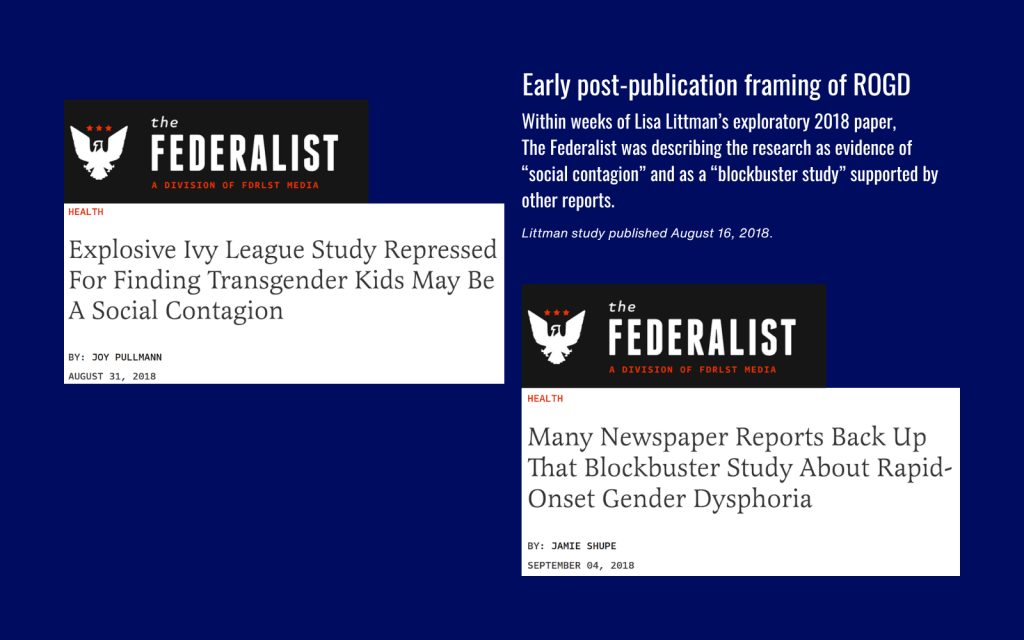
Author note: Jamie Shupe, who later used the name Elisa Rae Shupe, became a prominent detransition and anti-trans activist after previously obtaining legal recognition as nonbinary in Oregon. Shupe later re-transitioned, renounced their participation in anti-trans advocacy, and released thousands of emails from lawmakers, activists, physicians, and advocacy organizations involved in coordinated efforts to restrict transgender rights and gender-affirming care. Shupe later described their own participation in that work as “wrong, shameful, and harmful.” The released correspondence has since been used by journalists and legal scholars to document coordinated national strategy behind anti-trans legislation and restrictions on gender-affirming care.
At the same time, professional organizations were warning against treating the label as settled science. On September 4, the World Professional Association for Transgender Health (WPATH) stated that ROGD was not a recognized medical entity and described it as an acronym for a proposed phenomenon that might or might not warrant further investigation. WPATH specifically cautioned that “official-sounding labels” could lead clinicians, community members, or scientists to form premature absolute conclusions about adolescent gender-identity development.
Advocacy uptake followed quickly. On September 19, Parents of ROGD Kids thanked Littman for “giving us the words” to describe what they believed they were observing and said her study had “meticulously” quantified the phenomenon.
The relevant parallel for this audit is the speed of rhetorical elevation. Within weeks, an exploratory parent-report hypothesis was being presented in media shorthand as “social contagion,” a “blockbuster study,” and possible “formal academic validation.” That does not make ROGD and CGAS scientifically equivalent. It shows how quickly a newly named research construct can acquire broader political meaning before its evidentiary status is settled.
What Was HHS Trying to Learn?
In practice, the survey uses CGAS to test whether agreement with five selected propositions derived from clinical guidance is associated with left-wing authoritarianism, political identity, and judgments about political violence. It does not evaluate whether the underlying guidance is medically accurate, whether it improves or worsens patient outcomes, or how clinicians apply it.
CGAS’s immediate research function is therefore not to evaluate gender-affirming care. It converts agreement with selected propositions from that framework into a variable whose political and psychological correlates can be analyzed.
Why HHS commissioned this particular inquiry remains only partly documented. Before publishing the report, the department had adopted opposition to “gender ideology” as a policy objective; its public release subsequently framed the findings in explicitly ideological terms. That chronology makes institutional purpose a legitimate subject of scrutiny, but it does not establish the private intentions of the officials or researchers involved.
The public record does not identify who requested the research, what statement of work governed it, how the investigators were selected, what deliverables were specified, or what internal discussions preceded publication. Those records are needed to understand how a federal health agency selected and structured this political-psychology inquiry.
Burleton Education: Working Hypothesis
Burleton Education’s working hypothesis is that CGAS may have been useful to HHS less as a clinical instrument than as a political-attitude metric: a way to quantify agreement with selected gender-affirming propositions and relate that agreement to broader political and psychological categories. The survey’s design and HHS’s subsequent framing are consistent with that hypothesis, but they do not confirm it. Confirmation would require additional commissioning records or internal communications, which Burleton Education has requested through the Freedom of Information Act.
What the CGAS Results Can—and Cannot—Show
The CGAS provides a numerical summary of how strongly respondents agreed with five researcher-constructed statements derived from selected professional guidance. The survey can test whether scores on that bundle were statistically associated with responses on other measures in this sample.
The safest interpretation remains correspondingly narrow: a higher CGAS score means greater agreement with these five particular statements. It does not independently establish that the items measure a distinct or stable construct, and the cross-sectional design cannot establish causal direction or temporal sequence.
The report interprets that score as “clinical gender affirmation” and relates it to the broader category of “gender ideology”; HHS’s public release extends the framing to “radical gender ideology.” Those successive labels introduce interpretive claims beyond what the numerical score itself establishes; neither internal consistency nor statistical association independently validates those broader constructs.
CGAS and Left-Wing Authoritarianism
After defining CGAS and LWA separately, the report asks whether the two scores are associated. They are.
In the full sample of 1,208 respondents, CGAS and LWA had a Spearman correlation of ρ = .54, p < .001. In practical terms, respondents who scored higher on the five-item CGAS also tended to score higher on the 13-item Brief Left-Wing Authoritarianism Scale.
The report also fit a simple regression predicting LWA scores from CGAS scores and reported β = .56, R² = .315, F(1, 1206) = 554.60, p < .001. In this one-predictor model, the fitted relationship accounted for 31.5% of the variation in LWA scores within the sample. That percentage describes model fit; it does not mean that CGAS caused 31.5% of respondents’ authoritarianism.
These are substantial statistical associations. What they mean, however, depends on what the two instruments contain—which is why the measurement audits above matter.
What Does a Correlation of .54 Mean?
A Spearman correlation of ρ = .54 indicates a substantial positive association between respondents’ rank ordering on the two measures. Respondents with higher agreement across the five CGAS propositions generally also had higher aggregate scores on the Brief LWA Scale, which contains coercive, censorious, anti-conventional, and explicitly Left-coded propositions.
The coefficient does not mean that 54% of respondents who agreed with the CGAS items were authoritarian; a correlation coefficient is not a percentage. It also does not establish that CGAS causes LWA or that the two scales measure the same construct.
The narrow conclusion is that, within this sample, higher values on one score tended to accompany higher values on the other.
Why the 31.5% Figure Needs Careful Interpretation
The report emphasizes that CGAS “accounted for approximately 31.5% of the variance in LWA.” That figure comes from a simple regression using CGAS as the sole predictor of LWA; the model did not control for political identity or other covariates.
An R² of .315 means that the fitted relationship with CGAS accounted statistically for 31.5% of the observed variation in measured LWA scores within this sample. It does not mean that CGAS explains 31.5% of left-wing authoritarianism as a psychological phenomenon.
Because both variables are questionnaire scores containing politically and morally related content, their shared variance could reflect genuine psychological overlap, overlapping ideological content, political identity, general response tendencies, or other unmeasured characteristics. This model alone cannot distinguish among those possibilities.
The 31.5% figure is therefore a statement about covariation between two measured scores—not evidence that clinical gender affirmation causes or explains nearly one-third of authoritarian psychology.
What Happens After Political Identity Is Included?
The report also asks whether the CGAS–LWA relationship is merely a byproduct of ordinary left–right political identification. To examine that question, the researchers fit an ordinal regression with CGAS as the outcome and LWA, political identity, and age as simultaneous predictors. This analysis included the 1,192 respondents who could be placed on the left–right political spectrum.
More left-wing political identification was the strongest predictor of higher CGAS scores (β = .512, p < .001). LWA nevertheless remained positively associated with CGAS after political identity and age were included (β = .326, p < .001), while age had a much smaller positive association (β = .068, p < .01).
This is an important result: the CGAS–LWA association was not entirely captured by the particular political-identity measure used in the model. It also matters that political identity remained considerably more strongly associated with CGAS than LWA did (β = .512 versus β = .326).
Statistical adjustment has limits, however. Including political identity separates the association represented by that particular variable; it does not remove the political and ideological content of either scale, rule out other shared influences, or establish that the remaining association reflects a causal authoritarian process.
From Statistical Prediction to “Ideological Extremity”
The report moves beyond describing CGAS and LWA as statistically associated to a stronger interpretive claim: CGAS may capture “a form of left-wing ideological extremity,” while “gender ideology” may function as an “ideological accelerant.”
That is a major inferential step. The analyses show that higher CGAS scores were associated with higher LWA scores and, in separate later models, with greater justification of political violence after political identity was included. Those results do not themselves establish that CGAS represents ideological extremity or that gender-affirming clinical guidance accelerates authoritarian psychology.
The report’s proposed mechanism is more specific: what it calls “gender ideology content” may supply people already higher in LWA with targets, moral urgency, and justification for coercive action—in effect, telling authoritarian psychology who the enemy is, why the situation is urgent, and when force may appear legitimate.
That mechanism is a theoretical interpretation of the observed associations, not something demonstrated by this cross-sectional survey. The authors acknowledge that the data cannot determine whether CGAS-consistent beliefs influence LWA, whether people higher in LWA are more likely to endorse those beliefs, or whether another factor contributes to both. They call the present correlations a “discovery sample” and say a separate experiment is being designed as a preregistered “confirmatory causal test.”
An accelerant is not a neutral metaphor: it implies direction, temporal sequence, and intensification—the precise elements this survey does not establish. The distinction is straightforward: the survey establishes association; the “ideological accelerant” mechanism remains a hypothesis.
What Else Could Explain the CGAS-LWA Association?
The report interprets the association remaining after political identity and age are included as evidence consistent with a specifically authoritarian psychological process. Other explanations remain possible, however, and the cross-sectional design and limited set of covariates cannot distinguish among them.
Ideological sorting. CGAS contains propositions associated with contemporary progressive politics, while the Brief LWA Scale contains explicitly Left-coded political content. A single left–right political-identity variable may not fully capture issue-specific ideology, coalition affiliation, or ideological intensity. Respondents located within the same broader political coalition may therefore score higher on both measures even when authoritarianism is not the only shared factor.
Measurement overlap. The instruments do not duplicate one another’s items, but neither is politically neutral. LWA includes hostility toward conservatives, concern about right-wing extremism, censorship of right-wing websites, and other politically specific content. CGAS measures positions that have also become politically polarized. Their association may therefore reflect some shared political and moral content in addition to authoritarian disposition.
Broader moral or social orientation. Commitments involving equality, protection of marginalized groups, social inclusion, or opposition to perceived oppression could influence responses across both instruments without being synonymous with authoritarianism.
Burleton Education: Working Hypothesis
Burleton Education’s working hypothesis is that an equivalent examination of the conflict’s other side could reveal its own troubling associations. Low CGAS scores could reflect many different positions, ranging from disagreement with particular wording or clinical claims to anti-transgender hostility. Rejection of the propositions could also be associated with right-wing authoritarianism, social-dominance orientation, dehumanization, punitive attitudes, or support for coercive restrictions on transgender people—possibilities this survey does not test.
The resulting interpretive frame is structurally asymmetric: the research investigates potentially troubling psychological correlates of agreement with the CGAS propositions without examining an equivalent set of potentially troubling correlates associated with rejecting them.
None of these alternatives disproves the reported CGAS–LWA association. They show why the analyses do not identify the psychological mechanism responsible for it.
Burleton Education: Editorial Assessment
HHS’s public framing should not be read in isolation from the policy environment that preceded the report’s publication.
By August 2026, the department and the Trump administration had already adopted “gender ideology” as a political and policy category, used that language to characterize gender-affirming practices and institutions, and positioned opposition to those practices as a federal policy objective. HHS then released the report using that same vocabulary, translating CGAS findings into public claims about “radical gender ideology.”
That history does not prove a hidden or coordinated intent behind every wording choice. It does, however, make the interpretation that HHS was merely translating technical findings into neutral public language less persuasive. Burleton Education therefore treats the public presentation of CGAS not merely as a ‘ham-handed’ summary of survey results, but as communication occurring within an established anti-transgender political framework that already supplied the categories through which those results were publicly interpreted.
This remains an editorial inference rather than a documented finding about private intent. It should be reassessed if commissioning records, internal communications, or later disclosures show a substantially different purpose or framing process.
What the CGAS-LWA Relationship Actually Establishes
The most defensible conclusion is narrow: in this sample, greater agreement with the five CGAS propositions was associated with higher scores on the 13-item Brief Left-Wing Authoritarianism Scale, and that relationship remained statistically significant after the study’s political-identity measure and age were included.
This finding does not establish that agreement with gender-affirming guidance causes authoritarianism, that “gender ideology” accelerates authoritarian psychology, or what mechanism accounts for the observed relationship.
Political Violence
One of HHS’s most consequential public claims is not merely that CGAS and left-wing authoritarianism are associated. It is that respondents scoring higher on those measures were also more likely to rate certain acts of political violence as justified.
That finding warrants its own audit because the survey measured judgments about the justification of specified violent acts—not actual violence, plans, behavioral intent, or membership in violent groups.
What the Report Says Participants Rated
The report identifies six potential targets or forms of action for which participants provided political-violence justification ratings:
- killing Charlie Kirk
- killing Donald Trump
- killing Brian Thompson
- arson of ICE buildings
- damaging the property of wealthy people
- violence against police
The six ratings were analyzed as separate ordinal outcomes. They were attitudinal judgments—not measures of respondents’ behavior, plans, or intent.
The report does not reproduce the full respondent-facing prompts or response anchors for these outcomes in its scale appendix. The list above therefore reflects the report’s outcome labels, not necessarily the exact wording participants saw. Readers cannot independently inspect from the report alone how the questions were framed or what response options were provided.
That omission matters because describing an act as “justified,” “supported,” “personally willing to commit,” or “understandable under particular circumstances” would elicit different judgments.
The narrowest defensible description is that participants provided justification ratings for six specified violent or destructive political acts, and those ratings were compared separately with CGAS and LWA scores.
The Six Violence Items Are Not Politically Symmetrical
All six reported outcome labels can plausibly be read through a Left-coded political frame: killing Trump, Kirk, or Brian Thompson; arson of ICE buildings; damaging wealthy people’s property; and violence against police. That does not establish that every person endorsing any of these acts would be politically left-wing. It does mean that the outcome set emphasizes violence associated in contemporary discourse with Left-coded grievances or targets.
The report includes no comparison set involving violence plausibly associated with Right-coded grievances or targets, such as attacks against Democratic officials, abortion providers, LGBTQ+ people, racial or religious minorities, journalists, or election workers. This asymmetry does not invalidate the reported associations, but it limits what they establish about “political violence” generally. The study cannot determine whether its pattern is distinctive to Left-coded violence or would also appear with ideologically opposed targets.
How Strong Were the Associations With Political Violence?
The report found positive associations between both LWA and CGAS and justification of all six violence outcomes. But the strength of those associations differed substantially.
For LWA, the zero-order Spearman correlations ranged from ρ = .47 to .54, all p < .001:
- Kill Charlie Kirk: ρ = .49
- Kill Donald Trump: ρ = .51
- Kill Brian Thompson: ρ = .50
- Arson of ICE buildings: ρ = .54
- Damage wealthy people’s property: ρ = .49
- Violence against police: ρ = .47
For CGAS, the associations were consistently smaller, ranging from ρ = .23 to .35, all p < .001:
- Kill Charlie Kirk: ρ = .31
- Kill Donald Trump: ρ = .35
- Kill Brian Thompson: ρ = .27
- Arson of ICE buildings: ρ = .34
- Damage wealthy people’s property: ρ = .28
- Violence against police: ρ = .23
That pattern matters. In every zero-order comparison, LWA was more strongly associated with violence-justification ratings than CGAS was. The report likewise describes the CGAS correlations as smaller than the LWA correlations.
The researchers then fit two separate sets of proportional-odds ordinal regressions controlling for political identity. In the LWA models, LWA remained statistically significant across all six outcomes, with standardized coefficients ranging from β = .53 to .66. Political identity was weaker and was not statistically significant for killing Charlie Kirk or violence against police.
In the separate CGAS models, CGAS remained statistically significant across all six outcomes, with coefficients ranging from β = .19 to .42. Political identity was also statistically significant in all six models.
Crucially, the report did not include LWA and CGAS together in the same violence models. The analyses therefore show that each measure remained associated with violence-justification ratings after political identity was included; they do not establish whether CGAS contributes information beyond LWA.
Across all six zero-order comparisons, LWA—not CGAS—was the stronger correlate of violence justification. The adjusted models point in the same descriptive direction, but because LWA and CGAS were modeled separately, they do not provide a direct test of their unique contributions relative to one another.
That distinction matters because HHS’s public framing foregrounds “radical gender ideology.” The underlying results are more differentiated: the preexisting LWA measure shows the stronger associations, while the newly created CGAS shows weaker but still statistically significant relationships.
Statistical Significance Is Not the Same as Practical or Behavioral Risk
All twelve zero-order associations between LWA or CGAS and the six violence-justification outcomes were statistically significant at p < .001. A sample of 1,208 provides substantial power to detect associations, including comparatively modest ones. Statistical significance therefore does not, by itself, establish that an association is large, practically consequential, or predictive of real-world behavior.
Under the statistical model, p < .001 means that results at least this extreme would be unlikely if the true association were zero. It does not measure the size or importance of the relationship, establish causation, or estimate respondents’ probability of committing political violence.
Here, the outcomes were attitudinal judgments about whether specified acts were justified—not violent behavior. Assessing practical or behavioral significance requires attention to effect size, measurement validity, the population studied, and evidence that the measured attitudes predict behavior. A p-value alone cannot answer those questions.
What Does HHS Mean by “More Likely to Justify Political Violence”?
HHS describes higher-scoring respondents as “more likely to justify political violence.” In ordinary public language, “more likely” can sound like a statement about the probability of violent behavior. The underlying analyses do not estimate that probability; they relate questionnaire scores to ordinal ratings of how justified six specified acts were.
The most precise formulation is therefore: higher LWA and CGAS scores were associated, in separate analyses, with higher justification ratings for six selected acts of political violence.
Burleton Education: Editorial Assessment
What HHS’s Political-Violence Framing Does
Burleton Education cannot presently document why HHS chose this framing. What can be evaluated is the rhetorical function and foreseeable effect of the language it uses publicly.
HHS’s public language places “radical gender ideology,” left-wing authoritarian beliefs, and political violence within a single explanatory frame. The underlying study is narrower: CGAS records agreement with five propositions, while the violence outcomes record justification ratings for six selected acts.
Burleton Education’s assessment is that the broader framing invites readers to treat support for gender-affirming propositions as not merely politically controversial, but psychologically suspect and associated with danger. The politically asymmetric outcome set intensifies that effect because the study offers no corresponding examination of Right-coded authoritarianism, anti-transgender hostility, or Right-coded violence.
As established above, this communication occurred after the administration had adopted “gender ideology” as a federal policy category. Burleton Education therefore interprets the release as political communication operating within that framework, not as a neutral restatement of the measured variables. This remains an editorial inference, not a documented finding about private intent, and should be reassessed if commissioning records or internal communications provide contrary evidence.
What the Political Violence Results Can—and Cannot—Show
The report establishes that, in this sample, higher LWA and CGAS scores were associated, in separate analyses, with higher justification ratings for six selected acts of political violence. LWA had the stronger zero-order correlation in every comparison, and both measures remained statistically associated with the outcomes after political identity was included in separate adjusted models.
That is a meaningful but bounded statistical finding. The outcomes were attitudinal ratings of six selected scenarios whose targets and acts were politically asymmetric—not measures of violent behavior or intent, and not a politically balanced assessment of violence across ideological contexts. The results do not establish behavioral dangerousness or show that “radical gender ideology” causes political violence.
From Association to Causal Claims
The HHS report identifies cross-sectional statistical relationships among CGAS, LWA, political identity, and political-violence justification ratings. Its broader theory is directional, however: it proposes that what it calls “gender ideology content” may function as an “ideological accelerant” for authoritarian psychology.
Statistical association, statistical prediction within a model, and causal explanation are not interchangeable. The present survey establishes associations; whether those associations support the report’s directional theory requires separate scrutiny.
Cross-Sectional Data Cannot Establish Which Came First
All principal variables were measured within the same cross-sectional survey. The data therefore cannot determine whether stronger agreement with CGAS propositions preceded higher LWA scores, whether higher LWA preceded CGAS agreement, or whether another factor contributed to both.
The same limitation applies to the political-violence outcomes: the design cannot establish whether CGAS or LWA attitudes preceded the justification ratings—or whether the relationship runs in another direction. Assigning variables the roles of “predictor” and “outcome” inside a regression model does not establish temporal order in the real world. A directional metaphor such as “accelerant” therefore requires evidence about sequence that this study does not provide.
The Planned Experiment Is an Acknowledgment of the Current Evidentiary Gap
The report itself recognizes that the present survey cannot establish the causal pathway proposed by its broader theory. The authors call the current cross-sectional correlations a “discovery sample” and say a second study is being designed; they describe the planned preregistered experiment as the “confirmatory causal test.”
That terminology distinguishes two evidentiary stages. The current survey identifies associations that may generate or support a hypothesis. The proposed experiment is intended to test whether exposure to CGAS-consistent content produces the changes predicted by the authors’ theory. Until that study is completed and evaluated, the directional mechanism remains unconfirmed.
Nonetheless, HHS is already publicly promoting a report organized around that directional hypothesis. This does not make the hypothesis false, but it means the public narrative precedes the experiment the authors themselves identify as the causal test.
What Would Be Needed to Support a Causal Claim?
Supporting a directional causal claim would require evidence of temporal order and stronger tests of competing explanations. Longitudinal data could show which measured attitudes came first, although it would not by itself eliminate confounding. A well-designed randomized experiment could strengthen causal inference if it clearly defined and manipulated the proposed exposure, used validated outcome measures, and produced replicable results.
Even evidence that CGAS-consistent content affects responses in a survey or laboratory would not automatically establish that “gender ideology” causes real-world political violence. That broader conclusion would also depend on the validity of the constructs, the behavioral relevance of the outcomes, independent replication, and evidence that the effect generalizes beyond the research setting.
What the Report Does Not Test
The report tests a defined set of statistical relationships among CGAS, left-wing authoritarianism, political identity, and justification ratings for six selected acts of political violence. Those analyses are informative within that limited frame. Several questions relevant to HHS’s broader claims about “gender ideology,” authoritarianism, and political violence remain untested.
Identifying those omissions does not mean the authors were obligated to answer every adjacent question in a single study. The omissions become important because HHS publicly frames the findings in terms broader than the variables and outcomes directly measured.
The Report Does Not Test Right-Wing Authoritarianism
The report measures authoritarian tendencies only through the 13-item Brief Left-Wing Authoritarianism Scale. It includes no comparable measure of right-wing authoritarianism. Controlling for political identity does not fill that gap, because political identity is not itself a measure of right-wing authoritarianism.
The study therefore cannot determine whether the CGAS–LWA association is distinctive to Left-coded authoritarianism, whether CGAS scores would also be associated with Right-coded authoritarian tendencies, or how the relationships might differ across ideological camps.
The defensible conclusion is narrower: CGAS scores were associated with one specific measure of left-wing authoritarianism in this sample. The study does not compare authoritarian tendencies across the political spectrum.
The Report Does Not Test Anti-Trans Hostility or Prejudice
The report measures agreement with the CGAS propositions but includes no direct measure of anti-trans prejudice, hostility, dehumanization, or punitive attitudes toward transgender people.
Low CGAS scores could arise from markedly different positions: disagreement with particular wording or clinical claims, broader conservative or libertarian views, or explicitly hostile and exclusionary attitudes toward transgender people. Without a direct measure of those attitudes, the study cannot distinguish among these possibilities.
The resulting design is asymmetric. It examines potentially troubling correlates of agreement with the CGAS propositions without examining an equivalent set of correlates associated with rejecting them. It therefore cannot determine whether anti-trans hostility has its own associations with authoritarianism, coercive policy preferences, dehumanization, or justification of political violence.
The Report Does Not Test Whether the Findings Generalize Beyond These Six Violence Items
The six outcomes are a selected set of targets and acts, not a comprehensive or politically balanced measure of political violence. They concern three killings, arson against ICE buildings, damage to wealthy people’s property, and violence against police.
The study therefore cannot determine whether the same associations would appear for Right-coded political violence, violence directed at different groups, or acts arising in different circumstances. Its findings are item-bounded: they concern justification ratings for these six acts, not a generalized willingness to justify political violence across ideological contexts.
CGAS Does Not Measure Clinical Knowledge
CGAS measures agreement with five researcher-constructed propositions, not knowledge of transgender healthcare or the evidence underlying professional guidance. Participants were not assessed on relevant medical literature, treatment indications, contraindications, risks, benefits, standards of care, or areas of scientific uncertainty.
Agreement and knowledge are not interchangeable. A respondent could endorse all five statements while knowing little about transgender healthcare—or reject them while possessing substantial clinical knowledge. Neither a high nor a low CGAS score therefore establishes clinical literacy, expertise, or adherence to scientific evidence.
The Report Does Not Test the Clinical Accuracy of the Guidance It Uses
The report uses selected passages from professional guidance as source material for CGAS, but the survey does not evaluate whether those recommendations are clinically accurate, effective, or supported by strong evidence.
That separate question requires examination of the underlying research, evidence quality, benefits and harms, relevant patient populations, alternative interventions, and the circumstances in which each recommendation applies.
Associations between CGAS and political or psychological measures cannot resolve the clinical validity of the source guidance. The characteristics of the people who endorse or reject a medical proposition neither prove nor disprove that proposition.
The Report Does Not Test Whether Clinical Institutions Were “Captured” by Activism
The report raises the possibility that activism or ideological commitments shaped professional clinical guidance. The survey does not, however, examine institutional decision-making, guideline-development procedures, conflicts of interest, evidence-review standards, committee deliberations, or the processes through which recommendations were adopted.
Evaluating that hypothesis would require direct institutional evidence: what research was considered or excluded, how dissent and uncertainty were handled, who influenced the process, and whether advocacy goals displaced ordinary scientific standards. A correlation between public agreement with CGAS propositions and LWA scores cannot supply that evidence or explain why professional organizations adopted the underlying guidance.
Claims of institutional “capture” should therefore be treated as separate hypotheses, not as conclusions established by the CGAS correlations. That unresolved question also raises a distinct policy concern: whether the report could be used not merely to criticize clinical guidance, but to justify consequences for institutions associated with it.
Burleton Education: Working Hypothesis
HHS May Be Positioning CGAS to Support Funding Restrictions on Gender-Affirming Institutions
Burleton Education is examining whether the CGAS report may serve a function beyond public messaging: providing an empirical-seeming rationale for future federal funding restrictions affecting institutions associated with gender-affirming care, research, education, or professional guidance.
The hypothesis follows a documented sequence. The researchers constructed a numerical measure from five selected gender-affirming propositions and associated its scores with left-wing authoritarianism and justification ratings for political violence. HHS’s public release then translated those findings into the administration’s broader category of “radical gender ideology.”
The administration has already attached funding consequences to that policy category. In August 2025, HHS terminated California’s PREP grant after objecting to “gender ideology” in its materials, and the termination appears in HHS’s grants database. HHS and other agencies also incorporated the administration’s “gender ideology” framework into grant conditions, some of which were later preliminarily enjoined. These records establish an administrative precedent; they do not establish that CGAS played any role in those actions.
If CGAS-based framing becomes embedded in policy, institutions endorsing or implementing the underlying guidance could be characterized not simply as participants in a disputed clinical debate, but as promoters of an ideology that HHS has associated with authoritarianism and political violence. That characterization could carry consequences in grant administration, contracting, program eligibility, and other funding decisions.
Important boundary: Burleton Education has not identified evidence that CGAS itself has been invoked to terminate, reduce, condition, or deny federal funding. The narrower hypothesis is that the report may be constructing an additional evidentiary rationale that could later be incorporated into an existing practice of attaching funding consequences to the administration’s “gender ideology” framework.
Evidence supporting this working hypothesis:
- HHS/ACF, HHS Defunds California’s Attempt to Indoctrinate Children with Gender Ideology (Aug. 21, 2025), documenting termination of California PREP funding over “gender ideology” content
- HHS TAGGS, HHS Grants Terminated, corroborating the California PREP termination
- Rhode Island Coalition Against Domestic Violence v. Kennedy (D.R.I.), The district court preliminarily blocked challenged federal grant conditions in October 2025 and, on August 14, 2026, subsequently vacated the challenged conditions under the Administrative Procedure Act. The court found that the administrative records reflected efforts by HHS and HUD to align grant conditions with administration executive orders, including those addressing “gender ideology,” without sufficient reasoned explanation.
CGAS Has Not Been Validated Across Populations
The report analyzes CGAS as a five-item composite in one opt-in sample of U.S. adults. It does not establish whether the items have the same structure or whether the resulting score carries the same meaning among clinicians, parents, transgender people, adolescents, respondents with differing medical knowledge, or people in different political and cultural settings.
High internal consistency within one sample does not demonstrate equivalence across populations—a property commonly evaluated as measurement invariance. Until CGAS is tested across samples and settings, it should be understood as a newly introduced composite used in one survey, not as an established construct whose meaning has been shown to generalize broadly.
The Findings Have Not Been Independently Replicated
The reported CGAS–LWA and CGAS–violence associations come from the same dataset in which CGAS was introduced. The report—whose authors describe the current data as a “discovery sample”—provides no replication in a new sample or by an independent research team.
The proposed follow-up experiment, which the report says is being designed, may address a different causal question if it is conducted. It would not by itself independently replicate the present observational associations. These findings should therefore be treated as initial results requiring replication, not as settled evidence of stable psychological relationships.
The Findings Depend on the Measures Selected
The reported relationships depend on how each concept was measured: “clinical gender affirmation” through five researcher-constructed CGAS items, left-wing authoritarianism through one explicitly Left-coded 13-item scale, and political-violence justification through ratings of six selected acts.
Different measures could produce different associations. A broader survey of attitudes toward transgender healthcare, an authoritarianism measure with less partisan content, a politically balanced violence battery, or direct measures of prejudice and coercive policy preferences might yield a different pattern. The findings therefore establish relationships among these particular instruments—not among every plausible measure of the broader concepts assigned to them.
The Report Does Not Establish How Respondents Interpreted the Items
A survey response reflects both an item’s wording and the respondent’s interpretation of it. The report does not present cognitive interviews, respondent debriefing, or other evidence showing how participants understood CGAS phrases such as “affirm,” “transgender exploration,” and “necessary form of support,” or how they interpreted the selected political-violence scenarios.
Those phrases can carry different clinical, moral, and political meanings. Two respondents may choose the same answer for different reasons—or choose different answers despite holding similar underlying views.
The reported statistical relationships among the responses may be real without demonstrating that every respondent understood the items in the same way. CGAS scores should therefore be treated as recorded responses to particular wording, not as transparent measures of a uniformly understood psychological construct.
The Study Does Not Establish That the Pattern Is Specific to Gender-Affirming Beliefs
Even if the CGAS–LWA association is reliable, the study does not establish that it is specific to transgender issues or gender-affirming guidance. The researchers included no comparison scales measuring agreement with other contemporary Left-coded positions, such as reproductive rights, immigration, climate policy, labor protections, or other LGBTQ+ issues.
Without those benchmarks, the study cannot determine whether CGAS has an unusually strong relationship with LWA or merely follows a broader pattern of ideological sorting and coalition alignment. Similar associations across numerous progressive attitude scales would weaken the claim of specificity; an unusually strong CGAS association would strengthen it.
The present findings establish that CGAS and LWA covary in this sample. They do not establish that “gender ideology” occupies a distinctive psychological role compared with other politically polarized attitudes.
What These Omissions Mean for the Report’s Broader Claims
Taken together, these limitations do not negate the statistical relationships reported in the study. They define the boundaries of what those relationships can support.
In this sample, CGAS scores were associated with LWA scores and, in separate analyses, with justification ratings for six selected acts of political violence. The limitations examined above constrain how broadly those associations can be interpreted; they do not negate the statistical findings themselves.
The defensible conclusion is therefore narrow: the survey identifies covariance among particular questionnaire scores. HHS’s broader public framing invites conclusions about “gender ideology,” authoritarian psychology, institutional conduct, and political violence that require evidence this study does not provide.
What This Audit Establishes
The report’s significance lies in two distinct developments: it identifies limited associations among specific questionnaire scores, and HHS interprets those associations within a federal “gender ideology” framework that predated the report’s publication. The sections below distinguish what the CGAS research adds to that framework from what the public record still does not establish.
The Federal “Gender Ideology” Framework Predated the Report’s Publication
The report did not introduce “gender ideology” into federal policy. By the report’s public release in August 2026, the Trump administration was already using the term as a political and administrative category, had directed agencies to act against what it called “gender ideology,” and had incorporated that framework into health policy and grant administration.
HHS was also using the explicitly evaluative term “sex-rejecting procedures,” which outside advocates had proposed and urged federal officials to adopt. The administrative vocabulary through which the CGAS findings were presented was therefore already in place.
This chronology does not establish that the policy framework preceded the report’s commissioning or the development of CGAS; the public record does not disclose those dates. Nor does it prove that the statistical conclusions were predetermined. It does establish that the report entered an existing policy environment in which opposing “gender ideology” was an explicit governmental objective.
What the CGAS Report Adds to That Existing Framework
What the report adds is not the political category itself, but a new quantitative and psychological layer around it.
Researchers constructed a numerical score from agreement with five propositions derived from selected clinical guidance. In separate analyses, CGAS scores were associated with a 13-item measure of left-wing authoritarianism and with justification ratings for six selected acts of political violence. The report interprets these relationships using concepts such as “ideological extremity” and an “ideological accelerant,” while HHS’s public release extends them into claims about “radical gender ideology,” left-wing authoritarian beliefs, and political violence
The resulting interpretive sequence is shown below:

The survey establishes the CGAS score and the statistical associations described above. The transitions from that score to “clinical gender affirmation,” “gender ideology,” and “radical gender ideology” are interpretive steps beyond the propositions respondents actually rated.
Burleton Education Analysis:
From Policy Category to Empirical-Looking Classification
Burleton Education’s assessment is that the CGAS–LWA report may provide an empirical-looking psychological layer to a political category the administration had already established. That potential function takes on additional significance in light of the administration’s counterterrorism policy.
In May 2026—before the HHS report was released—the White House’s United States Counterterrorism Strategy identified violent secular political groups characterized in part by what it called “radically pro-transgender” ideology as a counterterrorism priority. The strategy called for federal counterterrorism capabilities to identify, map, and disrupt the violent secular political groups it placed within that category.
This creates a consequential policy sequence: the federal government incorporated “radically pro-transgender” ideology into its description of violent groups prioritized within a national counterterrorism framework, and HHS subsequently released research associating agreement with gender-affirming propositions with left-wing authoritarianism and justification ratings for political violence.
Burleton Education’s working assessment is that HHS’s subsequent public positioning of the research supplies an empirical and psychological layer to the administration’s existing “gender ideology” framework, while also placing those findings alongside a broader policy environment in which political violence and “radically pro-transgender” ideology had already been linked in federal counterterrorism language. Whether the research was commissioned with that function in mind remains unknown.
Taken together, the documented sequence shows convergence between HHS’s public framing of the research and a preexisting federal policy framework around “gender ideology.” The significance lies in the function of that convergence, regardless of whether it resulted from advance coordination: a political classification can acquire the appearance of an empirically characterized psychological category when preliminary research findings are presented through the same vocabulary.
Important boundary: The available records do not establish when the survey was commissioned or CGAS was developed, whether the research and counterterrorism initiatives were administratively coordinated, or whether CGAS has been used in any funding, regulatory, or enforcement action. The analysis above concerns the documented sequence and public function of HHS’s framing; it does not establish undisclosed commissioning intent, administrative coordination, or a predetermined purpose for the research.
Sources supporting this analysis:
The White House, United States Counterterrorism Strategy (May 2026), identifying violent secular political groups described in part as “radically pro-transgender” among national counterterrorism priorities and describing federal identification, mapping, and disruption efforts.
U.S. Department of Health and Human Services, HHS Releases Study Finding Individuals Who Associate with Left-Wing Authoritarian Beliefs and Radical Gender Ideology Are More Likely to Justify Political Violence (Aug. 26, 2026), documenting HHS’s public framing of the commissioned survey.
Executive Order 14168, Defending Women From Gender Ideology Extremism and Restoring Biological Truth to the Federal Government (Jan. 20, 2025), directing agencies to ensure federal funds do not promote “gender ideology.”
What the Public Record Still Does Not Show
The public record does not establish:
- precisely when the research was commissioned or when development of CGAS began;
- who within HHS originated or approved the specific research question;
- what statement of work, objectives, deliverables, funding mechanism, or other commissioning arrangement governed the project;
- how this particular research team was selected to conduct the work; or
- what internal HHS review, communications, or decision-making preceded publication and public rollout.
The available record also does not establish that HHS predetermined the results, directed the researchers to produce particular findings, commissioned the work to support a predetermined policy or enforcement objective, coordinated the research with the May 2026 counterterrorism strategy, or allowed any outside organization to design or control the project.
Burleton Education has likewise found no evidence that CGAS itself has been cited to terminate grants, restrict funding, deny program eligibility, or support regulatory action. Existing records document administrative and funding consequences associated with the administration’s broader “gender ideology” framework; they do not establish that CGAS itself has been used to determine those consequences.
Burleton Education has requested additional commissioning, funding, and communications records through pending Freedom of Information Act requests. In the meantime, additional public records and reporting can narrow some questions without resolving the central gaps identified above. Claims presented as documentary fact must therefore remain bounded by the available record, and Burleton Education’s editorial assessments should be revised if new records materially support, qualify, or contradict them.
Does the Report Cross Into “Junk Science”?
The audit above has addressed two related questions: what the HHS report actually establishes and how its findings may function within a broader federal policy framework. One question remains before reaching a final assessment: when do scientific limitations, interpretive overreach, and public presentation collectively become a misuse of scientific authority?
Preliminary, imperfect, or politically consequential research is not automatically “junk science.” Nor should the label be applied merely because findings conflict with Burleton Education’s views. If it is used here, it must follow from explicit criteria applied consistently to the report’s design, measurement, interpretation, and public framing.
Burleton Education: Criteria for Applying the Term “Junk Science”
1. An incompletely validated construct is treated as established.
A newly created measure may be useful for exploratory research, but its name, interpretation, or public use should not imply that it represents a stable psychological or clinical entity before construct validity, generalizability, and replication have been established.
2. The scientific authority of a measure exceeds what was actually measured.
A questionnaire score should not acquire clinical, psychological, or ideological meaning simply because researchers give it a technical name or derive its items from professional guidance.
3. Interpretive claims materially exceed the respondent-facing variables.
Statistical relationships among specific survey responses should not be translated into broader claims about an ideological system, psychological disposition, institutional corruption, or social danger without additional evidence supporting those constructs.
4. Correlation is used rhetorically as though it established direction, mechanism, or behavioral risk.
Cross-sectional prediction and association do not establish which variable came first, what caused what, or whether respondents are likely to engage in real-world behavior.
5. The design systematically examines one political side while broader conclusions are presented as though they describe a general phenomenon.
Politically asymmetric measurement may produce valid results about the variables actually measured, but it cannot establish that the observed pattern is unique, comparative, or representative across ideological camps.
6. Important scientific uncertainty is acknowledged but then outrun in interpretation or public presentation.
A report may appropriately describe findings as exploratory while authors, sponsors, or policymakers simultaneously communicate those findings as though the unsettled interpretation were already established.
7. The scientific product is used to legitimize a preexisting political classification beyond what the research itself demonstrates.
The concern becomes especially serious when a novel measure or preliminary association supplies apparent empirical authority to a policy category that existed before the research and already carries regulatory, funding, enforcement, or other institutional consequences.
No single criterion automatically makes research “junk science.” Burleton Education applies the term only when multiple, mutually reinforcing problems converge strongly enough that describing the work merely as preliminary, weak, or overinterpreted would understate the gap between the evidence and the scientific authority claimed for it.
Burleton Education assesses each criterion separately for the research/report itself and for HHS’s public framing and use of the findings. These are evidence-based editorial assessments, not scientific measurements or scores. The criteria can overlap and are not assumed to be independent or equally consequential. The final assessment therefore depends on the documented pattern across the criteria rather than on a numerical or quasi-numerical threshold.
Criterion 1 — An Incompletely Validated Construct Is Treated as Established
| Object Assessed | Finding |
|---|---|
| Research/report | Criterion applies, with important qualifications |
| HHS public framing/use | Criterion applies more directly to the public framing |
Research/report — evidence basis: CGAS is a newly created five-item measure with high internal consistency, but the report does not establish independent replication, cross-population stability, measurement invariance, or sufficient construct validity to show that “clinical gender affirmation” is a distinct and stable psychological construct. Nevertheless, the report gives the measure a formal construct label and interprets its composite score as representing that broader phenomenon. The qualification is important: creating and provisionally naming a new measure is legitimate exploratory research, and the authors describe further research as necessary. The concern arises because the report also gives the measure a formal construct label and interprets its composite score as representing a broader phenomenon before independent replication and fuller construct validation have been established.
HHS public framing/use — evidence basis: HHS publicly translates the newly created CGAS score into claims about “gender ideology” and “radical gender ideology,” giving a provisional measure the appearance of representing an established ideological category whose psychological significance has already been demonstrated. That public framing reduces the visibility of the measure’s provisional status and presents the resulting construct with greater apparent scientific certainty than the report’s validation evidence establishes.
Criterion 2 — The Measure Is Given More Scientific Authority Than Its Design Supports
| Object Assessed | Finding |
|---|---|
| Research/report | Criterion applies, with important qualifications |
| HHS public framing/use | Criterion applies more directly to the public framing |
Research/report — evidence basis: CGAS is presented under the formal label Clinical Gender Affirmation Scale, although it does not measure clinical practice, competence, diagnostic reasoning, treatment outcomes, or respondents’ knowledge of the underlying medical evidence. Its demonstrated function is a five-item public-attitude score constructed from reformulations of selected professional guidance. The qualification is important: the propositions are derived from genuine clinical guidance, so the measure’s clinical reference point is not invented. The concern is narrower—the formal name can imply that CGAS measures a broader clinical construct, while its demonstrated function in this study is to measure respondents’ agreement with five selected propositions derived from that guidance.
HHS public framing/use — evidence basis: HHS goes further by treating CGAS-related findings as evidence about “gender ideology” and “radical gender ideology,” assigning the measure ideological and psychological significance beyond what respondents were asked. That expansion makes the instrument appear to identify a broader and more established phenomenon than a five-item attitude measure can directly support.
Criterion 3 — Interpretive Claims Materially Exceed the Respondent-Facing Variables
| Object Assessed | Finding |
|---|---|
| Research/report | Criterion applies to the report’s interpretation |
| HHS public framing/use | Criterion applies to the public framing |
Research/report — evidence basis: Participants were not directly asked whether they endorsed “gender ideology” or “radical gender ideology,” nor were they assessed for a generalized disposition toward political violence. The survey also did not investigate the institutional processes necessary to test the report’s separate suggestion that activism or ideology had shaped professional clinical guidance. They completed five CGAS propositions, the 13-item LWA measure, and justification ratings for six selected acts. The report nevertheless interprets those responses through broader constructs such as “gender ideology,” “ideological extremity,” and an “ideological accelerant.” These interpretive constructs extend beyond the variables directly presented to and measured from respondents; their broader meaning therefore depends on additional inference rather than on the questionnaire responses alone.
HHS public framing/use — evidence basis: HHS broadens the interpretation further by publicly connecting “radical gender ideology,” left-wing authoritarian beliefs, and political violence. That framing exceeds the narrowest defensible description of the data: associations among particular questionnaire scores and justification ratings for six selected acts. It converts measured responses into a broader ideological and danger-related public category.
Criterion 4 — Correlation Is Used Rhetorically as Though It Established Direction, Mechanism, or Behavioral Risk
| Object Assessed | Finding |
|---|---|
| Research/report | Criterion applies, but is explicitly qualified in the report |
| HHS public framing/use | Criterion applies, but important causal and behavioral limitations are disclosed |
Research/report — evidence basis: The report advances a directional hypothesis in which “gender ideology” may function as an “ideological accelerant” for authoritarian psychology, although the cross-sectional survey cannot establish temporal order, causal direction, or mechanism. That language gives rhetorical prominence to a pathway the current study does not demonstrate. The authors nevertheless describe the present data as a “discovery sample,” acknowledge the causal limitation, and say a separate experiment is being designed as a “confirmatory causal test.” The report therefore gives rhetorical prominence to a possible causal pathway while also explicitly identifying that pathway as provisional and unconfirmed.
HHS public framing/use — evidence basis: HHS prominently connects “radical gender ideology,” left-wing authoritarian beliefs, and justification of political violence, creating a broader impression of danger around the measured attitudes. However, the release expressly states that the study does not determine causal direction, that an outside factor may contribute to both predispositions, and that it did not measure violent behavior or intent. The public language is rhetorically stronger than the underlying association, but the central causal and behavioral boundaries remain explicit.
Criterion 5 — Asymmetric Measurement Is Used to Support Broader Claims
| Object Assessed | Finding |
|---|---|
| Research/report | Criterion applies, with important scope qualifications |
| HHS public framing/use | Criterion applies more directly to the broader public framing |
Research/report — evidence basis: The study combines an explicitly Left-coded authoritarianism scale, CGAS propositions associated with contemporary progressive politics, and six politically asymmetric violence outcomes. It includes no mirrored measures of right-wing authoritarianism, anti-trans hostility, punitive attitudes toward transgender people, or Right-coded political violence. That design can establish relationships among the variables measured, but it cannot show that the pattern is distinctive to the political Left, distinctive to gender-affirming beliefs, or representative across ideological camps. The qualification is important: the report expressly focuses on left-wing authoritarianism and does not claim to have directly compared both sides. The asymmetry therefore limits the comparative reach of the findings; it does not by itself demonstrate improper study design or researcher intent.
HHS public framing/use — evidence basis: HHS publicly presents the findings through broader language about “radical gender ideology,” left-wing authoritarian beliefs, and political violence without an equivalent comparison showing whether similar or stronger relationships appear in Right-coded ideological structures. Without an equivalent comparison, that framing cannot establish whether the reported relationships are distinctive to Left-coded ideological structures or how they compare with analogous Right-coded measures. At the same time, HHS identifies the authoritarianism measure as left-wing rather than representing the study as a direct comparison of authoritarianism across ideological camps.
Criterion 6 — Public Interpretation Outruns Acknowledged Uncertainty
| Object Assessed | Finding |
|---|---|
| Research/report | Criterion applies, but the report prominently acknowledges key uncertainties |
| HHS public framing/use | Criterion applies more directly to the public framing |
Research/report — evidence basis: The report acknowledges that the survey is cross-sectional, causal direction remains unresolved, CGAS is newly created, and the current dataset is a “discovery sample.” It also describes a future experiment as a “confirmatory causal test.” Those acknowledgments materially count in the report’s favor. The report nevertheless foregrounds broader theoretical language about “ideological extremity” and an “ideological accelerant” before the proposed mechanism has been demonstrated. Because those limitations remain explicit and the proposed mechanism is presented as provisional, the report itself preserves meaningful uncertainty even while using broader theoretical language.
HHS public framing/use — evidence basis: HHS foregrounds “radical gender ideology,” left-wing authoritarian beliefs, and political violence in its headline and opening claims. The release later states that causal direction is unresolved and that the study did not measure violent behavior or intent, but those boundaries receive less prominence than the broader danger-related framing. The caveats are therefore genuine, but their placement and prominence differ from the stronger interpretive language used in the headline and opening presentation. The public framing consequently gives greater prominence to the broader interpretation than to the uncertainties that constrain it.
Criterion 7 — The Scientific Product Lends Authority to a Preexisting Political Category
| Object Assessed | Finding |
|---|---|
| Research/report | Criterion applies, with important limits on what can be inferred about purpose |
| HHS public framing/use | Criterion applies directly to the public framing and use |
Research/report — evidence basis: The federal “gender ideology” policy category predated the report’s public release, although the available record does not establish whether it preceded the commissioning of the research or development of CGAS. The report interprets a newly created five-item attitude score through broader concepts such as “gender ideology,” “ideological extremity,” and an “ideological accelerant.” That quantitative and psychological language can make a preexisting political category appear empirically characterized. The distinction is important: the report itself imposes no policy consequences, and the available record does not establish that the researchers designed the study to support the preexisting policy category. This criterion therefore concerns how the report’s constructs can function within that existing framework, not an established purpose behind the study’s design or commissioning.
HHS public framing/use — evidence basis: HHS places the findings directly within a federal framework that had already defined “gender ideology” as a target of government action and attached administrative and funding consequences to that classification. Its public release recasts higher CGAS scores as belief in “radical gender ideology” and connects that category with left-wing authoritarianism and political violence. In that broader policy context—including the counterterrorism strategy’s use of “radically pro-transgender” in describing certain violent groups—HHS’s presentation places the survey findings within language that overlaps with an existing federal political classification. The resulting public framing can give that classification an appearance of scientific and psychological characterization beyond what CGAS itself directly measures.
Burleton Education Editorial Assessment
Burleton Education’s qualitative review produces a clear distinction between the underlying research and HHS’s public use of it.
Assessment of the Underlying Research
The survey is not worthless research. Creating a new scale, investigating politically sensitive questions, and reporting exploratory associations are legitimate scientific activities. The authors also acknowledge important limitations: they describe the current dataset as a “discovery sample,” recognize that causal direction remains unresolved, and say a separate causal experiment is being designed.
The report nevertheless moves beyond those bounded findings. It gives a newly created five-item public-attitude score the formal name Clinical Gender Affirmation Scale, treats the composite as representing a coherent construct, relates it to an explicitly Left-coded authoritarianism measure and six politically asymmetric violence outcomes, and interprets the results through broader concepts such as “gender ideology,” “ideological extremity,” and an “ideological accelerant.”
Across the criteria above, the underlying report contains important instances of interpretive overreach, particularly in the authority assigned to a newly created measure and the broader constructs used to interpret its results. At the same time, the report acknowledges significant limitations, presents key causal propositions as provisional, and describes further research as necessary. Burleton Education therefore does not conclude that the underlying research, considered on its own, warrants a “junk science” designation.
Assessment of HHS’s Public Framing
HHS’s public presentation warrants a different judgment. It recasts a provisional five-item attitude score as belief in “radical gender ideology” and foregrounds its associations with left-wing authoritarianism and political-violence justification. Although the release acknowledges that causal direction is unresolved and that the survey did not measure violent behavior or intent, those caveats do not resolve the more fundamental interpretive leap from CGAS responses to a broader ideological classification.
This goes beyond ordinary simplification for a public audience. HHS uses limited exploratory associations to lend scientific authority to a broader political and psychological category whose governmental significance existed before the report’s publication, even though the study itself does not independently establish that broader category as a validated scientific construct.
That transformation is especially consequential because the administration’s “gender ideology” framework already carries funding and administrative consequences, and because its counterterrorism strategy had already included “radically pro-transgender” ideology among the descriptors of certain violent groups. This context does not establish coordination or undisclosed intent, but it increases the potential significance of HHS’s framing.
Applying the criteria defined above, Burleton Education’s editorial assessment is that HHS’s public use and framing of the research crosses into what we define here as “junk science”: the use of limited scientific findings and scientific authority to support claims materially broader than the underlying research establishes.
What This Judgment Does—and Does Not—Mean
Burleton Education is not alleging that the dataset was fabricated, that the reported associations are necessarily false, or that exploratory research is illegitimate. We use “junk science” here to describe HHS’s use of scientific terminology and statistical authority to support a political and psychological narrative that materially exceeds what the underlying research establishes.
The most defensible scientific conclusion remains much narrower:
In this sample, people who agreed more strongly with five selected gender-affirming propositions also tended to score higher on one specific measure of left-wing authoritarianism and, in separate analyses, to give higher justification ratings to six selected acts of political violence.
That finding merits further study. It does not independently validate “radical gender ideology” as a scientific construct, establish a causal pathway to authoritarianism, or show that people who support gender-affirming guidance are behaviorally dangerous.
The “junk science” problem arises in the transformation of that bounded finding into a much broader public claim.
This is Burleton Education’s editorial judgment, not a formal scientific classification. It should be revisited as additional evidence becomes available—including independent replication, further CGAS validation, results from the proposed causal experiment, commissioning or funding records, internal HHS communications, or other evidence that materially supports, qualifies, or contradicts this assessment.
Research and editorial assistance: This analysis was researched and written by Jenn Burleton with assistance from OpenAI’s ChatGPT for source discovery, evidence checking, methodological review, red-team analysis, and editorial refinement. Jenn Burleton determined the article’s arguments, interpretations, structure, and final wording, and independently reviewed and approved the published content.