


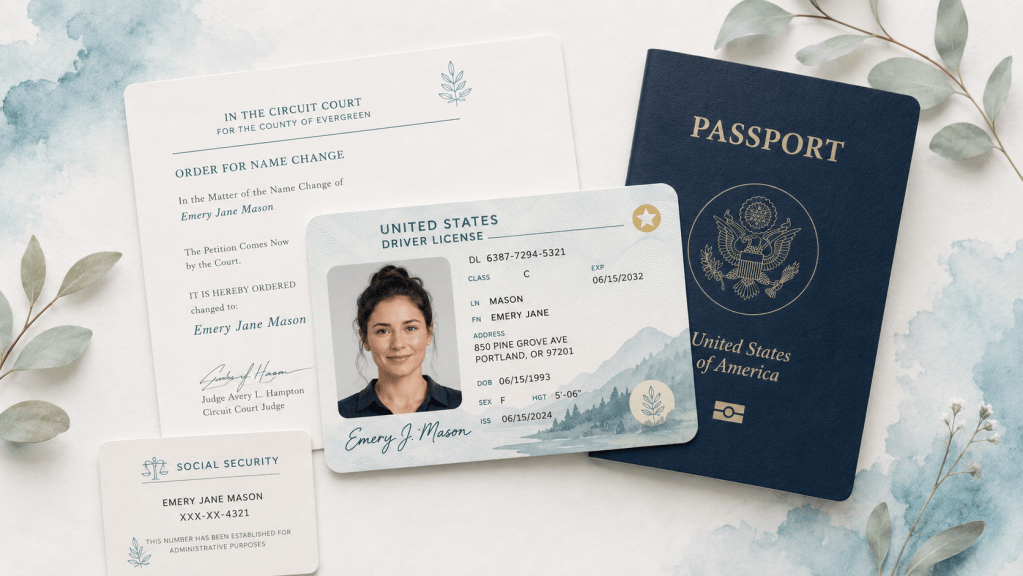
Practical Resources:
Identity Documentation
Updating identity documents can be practical, emotional, expensive, and sometimes risky. The rules vary by state, document type, agency, age, immigration status, and court process. This page gathers starting points for name changes, gender marker updates, federal identity documents, school and workplace records, and state-by-state legal help.
Because laws and agency policies change quickly, treat this page as an orientation guide—not legal advice. Before filing forms, paying fees, or surrendering original documents, check the current instructions from the issuing agency or a qualified legal-support organization.
On This Page
Disclaimer
Important note: Identity-document policies are changing rapidly. Some agencies may accept updated records, while others may reject, delay, reverse, or reissue documents under newer restrictions. If your safety, immigration status, custody situation, school enrollment, employment, housing, or travel plans could be affected, consider speaking with a legal clinic or attorney before starting.
State IDs, Birth Certificates, and Legal Name Changes
State identity documents are usually the first place people look when updating a name or gender marker, but the process is not uniform across the United States. Driver licenses, state ID cards, birth certificates, and court-ordered name changes are controlled by different state agencies, and the requirements can vary widely.
A practical starting sequence is:
1. Check your state’s current rules for driver licenses/state IDs and birth certificates.
2. Confirm whether a court order is required for a legal name change, a gender marker change, or both.
3. Make several certified copies of any court order before updating other records.
4. Update documents in an order that reduces conflicts between records.
5. Keep scans or photos of submitted forms, receipts, and correspondence.
Note: Some states allow relatively direct gender-marker updates. Others require court orders, medical documentation, proof of surgery, or may restrict changes entirely. Because policies can change quickly, use current state-specific guides before relying on older instructions.
Suggested resources:
Federal Identity Documents
Federal identity documents may not follow the same rules as state IDs or birth certificates. A person may be able to update one record while another agency refuses, delays, or reissues a document under a different policy. That mismatch can create practical problems with travel, employment verification, school records, immigration documents, banking, benefits, and safety.
Current federal policy is especially restrictive for passports, Social Security records, and some immigration-related documents. For passports, applications requesting an X marker or a marker different from the sex assigned at birth may be subject to delay. Before submitting an application, mailing original documents, or replacing a still-valid document, check the current agency instructions and consider whether legal support would be helpful.
Practical starting points:
1. Confirm whether your federal document can currently be updated for name, sex/gender marker, or both.
2. Check whether the agency requires original or certified documents.
3. Avoid surrendering a still-valid passport or immigration document without understanding the possible consequences.
4. Keep copies or scans of every form, court order, receipt, letter, and agency response.
5. If records conflict, consider getting legal guidance before travel, employment verification, immigration filings, or benefit applications.
For U.S. passports, the State Department currently says it no longer issues passports or Consular Reports of Birth Abroad (CRBA) with an X marker and only issues M or F markers that match the sex assigned at birth. For Social Security records, people may still be able to update a legal name with proper documentation, but SSA guidance currently says the agency is not processing sex-marker changes except for certain keying errors. USCIS has also adopted restrictive federal sex-marker guidance for benefit requests and some secure identity documents.
Note: Because these policies are actively contested and may change, use current official agency pages and trusted legal-support resources before taking action.
Suggested resources:
School, Employment, and Healthcare Records
School, employment, and healthcare records often contain both legal identity fields and everyday-use identity fields. People may need one record updated for legal compliance while also asking another system to use the correct name, pronouns, title, or gender marker in daily interactions.
These records can matter in practical ways: transcripts, diplomas, student accounts, payroll, tax forms, benefits enrollment, insurance claims, patient portals, pharmacy systems, referral letters, and emergency contacts may all pull from different databases. When one system changes, and another does not, mismatches can create confusion, outing risks, denial of services, or delays.
Practical starting points:
- Ask which records require a legal name change and which can be updated through a preferred/chosen name process.
- For school records, ask what is recorded, where it is recorded, who can access it, and whether the school has a student privacy or safety protocol before chosen-name or pronoun information is entered into a parent-accessible system.1
- Request written instructions before submitting documents.
- Ask whether old names or gender markers will remain visible to staff, teachers, employers, insurers, providers, or third-party vendors.
- Keep copies of every request, form, email, portal message, and response.
- If a school, employer, clinic, insurer, or provider refuses to correct inaccurate records, ask what appeal, grievance, privacy, or records-amendment process is available.
For schools, the Family Educational Rights and Privacy Act (FERPA) generally gives parents, and eligible students after FERPA rights transfer to them, the right to request correction or amendment of education records. For workplaces, employment records may involve payroll, tax, benefits, background checks, security, or licensing systems, so updates may need to happen in more than one place.
The Equal Employment Opportunity Commission (EEOC) states that discrimination against an individual because of transgender status is discrimination because of sex under Title VII.2
For healthcare records, HIPAA gives people the right to request amendments to certain medical or billing records when information is inaccurate or incomplete.
Note: Because these systems can be fragmented, the safest approach is to ask for the record-update process in writing, keep a paper trail, and avoid assuming that one update will automatically flow through every related system.
Footnotes:
(1) FERPA does not prohibit schools from giving students additional privacy-respecting rights or procedures. But for students who are not yet “eligible students,” FERPA generally preserves parent access to inspect and review education records, so schools should be careful not to promise confidentiality for chosen-name or pronoun information that is maintained in records accessible to parents. See 34 C.F.R. § 99.5(a)-(b); 34 C.F.R. § 99.10.
(2) As of May 3, 2026, the EEOC Sex-Based Discrimination page has the following message posted: “The information on this webpage is being reviewed for compliance with the law and executive orders and will be revised.”
Suggested resources:
State-by-State Legal Help
Identity-document rules are not only different from state to state; they can also vary by county, court, school district, agency office, or local clerk. A name-change petition, birth certificate correction, gender marker update, sealed-record request, or minor’s petition may have different forms, fees, notice requirements, publication rules, or safety exceptions depending on where the person lives or where the original record was issued.
State-specific legal help can be especially important when a person is dealing with a minor’s name change, parental consent questions, custody orders, immigration documents, criminal-record issues, sealed records, domestic violence or stalking concerns, homelessness, foster care, disability benefits, or urgent travel needs.
Practical starting points:
1. Use current state-specific guides before filing forms or paying fees.
2. Check whether your county court has its own local forms or instructions.
3. Ask whether fee waivers, publication waivers, sealed-record options, or safety-related confidentiality protections are available.
4. If the request involves a minor, confirm whether all parents or legal guardians must receive notice or consent.
5. If there are safety, immigration, custody, criminal-record, or housing concerns, try to consult a legal clinic before filing.
6. Keep copies of all forms, court orders, certified records, receipts, and agency responses.
Note: Be cautious with older guides, blog posts, or informal advice. Identity-document rules are changing quickly, and a process that worked in one state—or even one county—may not work somewhere else.
Suggested resources:
- Advocates for Trans Equalithy (A4TE) — ID Documents Center
- Movement Advancement Project (MAP) — Identity Document Laws and Policies
- LawHelp.org — Find Legal Help
- Legal Services Corporation — I Need Legal Help
- ACLU — Know Your Rights: LGBTQ Rights
- Lambda Legal — Help Desk
- Transgender Law Center — Get Help
Practical Safety Notes
Identity-document updates can improve safety, privacy, travel, school access, employment, healthcare, and daily life. But the process can also create short-term exposure. A court filing, published notice, parent-accessible school system, employer database, patient portal, insurance claim, travel document, or public-facing record may reveal information a person was not ready to disclose or does not feel safe disclosing.
Safety planning does not mean a person is doing anything wrong. It means recognizing that systems can be inconsistent, records can be shared more widely than expected, and anti-trans bias can make ordinary paperwork more risky than it should be.
Practical starting points:
1. Before filing, ask whether any part of the process creates a public record, published notice, searchable court entry, or parent/guardian notification.
2. Consider whether old names, gender markers, addresses, phone numbers, or emergency contacts may remain visible in portals, school systems, HR systems, insurance records, pharmacy profiles, or vendor databases.
3. Keep digital and paper copies of forms, receipts, court orders, agency letters, and screenshots of online submissions.
4. If safety is a concern, ask about fee waivers, publication waivers, sealed records, confidential address programs, and domestic violence or stalking protections before filing.
5. Avoid surrendering original identity documents until you understand whether and when they will be returned.
6. If travel, immigration status, custody, housing, school enrollment, employment, or healthcare access could be affected, consider speaking with a legal clinic or trusted advocate first.
7. If someone else monitors your phone, email, browser history, mail, school account, insurance account, or patient portal, use a safer device or account before researching or submitting forms.
Note: A person should not have to become a records-management expert just to have accurate documents. But until systems are safer and more consistent, careful documentation, trusted support, and privacy planning can reduce the risk of being delayed, outed, denied services, or placed in danger.
Suggested resources:
Related Practical Resources
Identity-document updates often connect to other practical needs — legal support, school safety, healthcare access, and knowing what rights apply in a given setting. Explore the rest of the Practical Resources subsection to keep going.