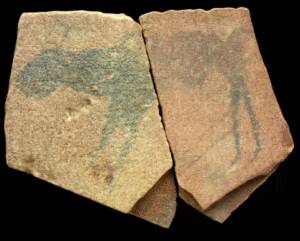
40,000-year-old art from the “Apollo 11” cave in Namibia, Southwest Africa.
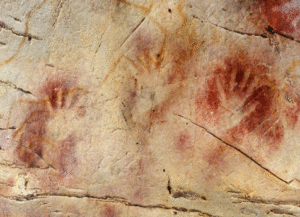
40,000-year-old hand stencils from Spanish Cantabria region.
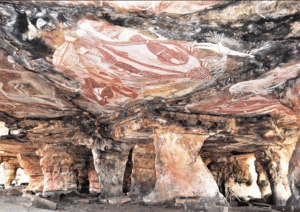
28,000-year-old Aboriginal art at Gabarnmung Cave, Australia.
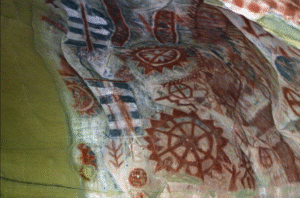
2,000-year-old Chumash rock art from Northern California.
Indigenous non-textual history traditions are systems for recording, transmitting, and preserving cultural knowledge without reliance on written language. Instead, history is carried through embodied, communal, and ecological practices—such as oral storytelling, songs, dances, carved or woven mnemonic devices, land-based markers, ceremonial performance, kinship structures, and seasonal rituals.
Because they are interactive and adaptive, non-textual systems allow histories to remain connected to place, community, and lived experience, ensuring continuity across generations even when disrupted by colonization.
Key Developments
Emergence of oral narratives to transmit knowledge across generations.
Development of ritual performance as a stable memory format.
Earliest rock art traditions worldwide (Australia, Africa, Europe).
Formation of seasonal knowledge cycles tied to hunting/gathering.
Regions
Australia: earliest Dreaming storylines emerge.
Sub-Saharan Africa: proto-initiation rites, clan histories.
Northwest Eurasia: early ritual dances, animal-based symbolic systems.
Key developments
Memory is encoded directly into landscape landmarks.
Emergence of astronomical alignments in Indigenous structures.
Early ceremonial sites encoding seasonal/ritual knowledge.
Oral traditions stabilize as core cultural archives.
Examples
Göbekli Tepe (12,000–10,000 BP): ritual architecture encoding cosmology.
Australian Songlines refined as continental-scale mnemonic systems.
Americas: large-scale earthworks used as cultural memory anchors.
Key developments
Development of complex portable mnemonics:
Carved stones, tablets, bones, and shells.
Patterned basketry, textiles, and tattooing as knowledge carriers.
Rise of kinship-based law systems, orally transmitted but ritually anchored.
Expansion of long-distance trade networks → broader narrative cross-linking.
Examples
Pacific navigation knowledge encoded in wave-piloting traditions.
Indigenous North American beadwork systems begin long lineages.
Andean proto-quipu forms emerge as organizational memory devices.
Key developments
Ceremonial social systems become highly structured.
Memory systems tied to governance and diplomacy.
Ritual specialists (elders, historians, navigators) emerge as defined roles.
Examples
Early khipu (quipu) in Andean civilizations.
Expansion of story-knives traditions among Arctic peoples.
Polynesian star-compass systems formalized for deep-ocean navigation.
Key developments
Highly formal oral systems flourish before widespread writing:
Genealogical epics, law recitations, cosmological cycles.
Song cycles and dance-drama as structured mnemonic archives.
Material memory systems reach high artistic complexity.
Examples
Haudenosaunee Wampum diplomacy systems begin to appear (c. 1100 CE).
Northwest Coast crest poles encode lineage rights and histories.
Aboriginal Australian ceremonial cycles diversify across regions.
Andean khipu bureaucracy formalizes before the Inca.
Key developments
Memory systems operate at continental scale.
Highly refined systems for administration, law, and cultural history.
Examples
Inca Empire:
Khipu used for census, tribute, historical recording + cosmic calendars.
Polynesia:
Navigational schools train specialists using star paths, swell patterns, oral maps.
North America:
Intensification of Wampum belts documenting treaties, constitution-making.
Flourishing of Plains ledger-style oral histories (before contact).
Key developments
State suppression of Indigenous cultural transmission.
Many traditions forced underground or restructured to avoid erasure.
Some non-textual systems recruit new materials (glass beads, cloth, metal).
Examples
Haudenosaunee use wampum systems to negotiate with European powers.
Pueblo ceremonial cycles maintained in secrecy.
Aboriginal Australian songlines used to hide or preserve sacred knowledge.
African kingdoms maintain memory board systems (e.g., Luba lukasa).
Key developments
Widespread recovery and public revitalization of non-textual systems.
Anthropologists begin documenting surviving memory technologies.
Indigenous cultural scholars reinterpret colonial-era misreadings.
Digital tools used to archive oral traditions while maintaining sovereignty.
Examples
Polynesian navigation renaissance (Hōkūleʻa voyages, 1970s–present).
Re-emergence of Northwest Coast crest pole carving traditions.
Andean revitalization of khipu knowledge and cosmology.
Australia: major legal recognitions of Dreaming-based land claims.
Indigenous-led digital archives:
language revitalization,
story maps,
clan knowledge databases with cultural permissions.