4.9 satisfaction rating/14k+ learners

The Light of Day:

Exposing Tools of Hate

Extremist disinformation and hate come in many forms, wearing different hats, and carrying signs and symbols that represent and promote transmisia (hatred of trans+ people) through theocratic mythologies, toxic masculinity, authoritarianism, political mobilization, racism, and Trans Exclusionary Radical Feminism.

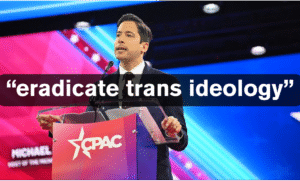
They share an ultimate goal: socially erasing, then eradicating trans+ people through suicide induced by fear, hopelessness, and denial of access to human rights, civil rights, gender-affirming healthcare, and genocide by legislation and authoritarian policies.

-Jenn Burleton

Defending The Premise

Social Erasure

Social erasure refers to the systematic isolation, suppression, distortion, and/or non-recognition of a group, identity, event, or knowledge system within the cultural, political, or historical record. It can occur through omission, censorship, forced assimilation, archival destruction, epistemic reframing, structural exclusion, or coordinated action.

Major Organizations Driving Social Erasure:

  • Alliance Defending Freedom (ADF)
  • Focus on the Family & Family Policy Alliance
  • Heritage Foundation
  • Family Research Council
  • American College of Pediatricians
  • Women's Liberation Front (WoLF)

Key Strategists & "Messengers":

  • ADF lawyers
  • Ryan T. Anderson (Heritage Foundation)
  • Family Policy Alliance "Ask Me First" campaign
  • Matt Walsh (The Daily Wire)
  • Ben Shapiro (The Daily Wire)
  • Laura Ingraham (FOX News)
Systematic Isolation

BIG PICTURE

"Bathroom Bills" create a precedent: if a trans girl is defined as “male” for bathrooms, the same definition can be extended everywhere else.

Framing The Discrimination

The emergence of anti-trans "bathroom bills" in 2013-20141 (see footnote below) was framed by those pushing such bills as being about "public safety" or "privacy" concerns; however, the documented evidence behind them reveals a different set of goals.

After decades of self-isolation by trans+ people fearful of social stigmatization and abuse, the growing public and legislative advocacy for the rights of trans+ people from 1990 to 2010 led to increasing visibility and participation in areas of social life that had been denied to them. This increased visibility did not make transmisic, mythology extremists, and Trans Exclusionary Radical Feminists (TERFs) happy.

In 2013, Christian Nationalists coordinated local, regional, and national campaigns to manufacture a supposed "danger" related to trans girls and women using sex-segregated girls'/women's restrooms. They did this as a mechanism of social exclusion and isolation, and to establish a legal foothold for increasingly extreme actions, including:

  • Bans on gender-affirming healthcare.
  • Restrictions on name and gender marker changes.
  • Exclusions in sports.
  • Rollbacks of anti-discrimination protections.
  • Curriculum laws that limit discussion of gender.

There has never been any evidence that remotely suggests that the use of girls'/women's restrooms by transgender girls and women is dangerous, or threatens anyone's personal privacy other than, most likely, that of the transgender girl or woman, due to harassment from others.

What Is The Real Intention of "Bathroom Bills"?

  • To restrict transgender people's public participation.
    • If a person can't use a public restroom matching their gender identity, then they can't go to the mall, to school,  their place of employment, or anywhere beyond their front door.
  • To force trans people back in "the closet".
  • To discourage social gender transition in PK-12 and higher education.
  • Create fear of harassment, policing, or punishment.

This aligns with broader patterns in civil rights history, in which targeting essential public facilities (restrooms, water fountains, schools) is used to limit a minority group's full participation in society.

Suppression

On June 21, 2016, Donald Trump held a private meeting in New York City with around 1,000 “social conservative”/evangelical-Christian leaders.  Moderated by former Arkansas Governor Mike Huckabee, the meeting was "an effort to get Trump to better understand their policy positions.

The Donald J. Trump administration has suppressed or rolled back rights and access for transgender people — drawing on documented policies, executive orders, and their effects. I cover both the first Trump presidency (2017–2021) and the continuing / renewed actions under his current term.

Military service ban

  • Under Executive Order 14183, signed January 27, 2025, the government ordered the Department of Defense to exclude people whose gender identity differs from their biological sex despite a total lack of evidence that transgender service negatively impacts military readiness and effectiveness.

Restricting Access to Gender-Affirming Care for Minors

  • The MAGA Party (aka Trump Administration) has moved to limit or eliminate access to gender-affirming care for minors. Under Executive Order 14187, federal funding for gender-affirming care for people under 19 was halted.
    • This ignores decades of medical consensus that gender-affirming care for youth is predominantly beneficial.

Rescinding Nondiscrimination Protections

Starting on the first day of his second term, President Trump began to issue numerous anti-science, non-evidence-based executive actions, several of which directly address or affect health programs, efforts, or policies to meet the health needs of LGBTQ+ people.

  • EO 14148 (rescinded EOs 13988, 14004, 14020, 14021, 14075)

Instituting Christian Nationalism Through Executive Orders, Memorandums and Proclamations

Non-Recognition of Identity
Non-Recognition of Event
Destruction of Knowledge Systems
Relevant Timelines

"Are Trans Rights In Danger?"

That question was asked of three different AI chat bots in mid-September, 2025, shortly after the murder of Christian Nationalist Charlie Kirk. Select a tab to learn how each answered the question.

Overview

Yes, transgender rights are facing significant threats globally, but particularly in the United States as of September 2025. This assessment is based on a surge in restrictive legislation, executive actions, and cultural backlash that have eroded legal protections, access to healthcare, and public safety for transgender individuals. While advocates have successfully blocked many proposals, the volume and extremity of attacks—especially post-2024 U.S. election—indicate a coordinated effort to limit transgender visibility and autonomy. These threats disproportionately affect transgender youth and women, exacerbating mental health crises, discrimination, and violence. However, resistance from civil rights groups and courts has preserved some gains, and public opinion remains mixed, with growing support for restrictions alongside broader acceptance of anti-discrimination measures.

Key Threats in the United States

The U.S. has seen an unprecedented escalation in anti-transgender policies since early 2025, driven by state legislatures and federal executive actions under President Trump. Over 500 anti-trans bills were introduced in 2023-2024, a trend continuing into 2025 with legislation in 49 states. While most fail to pass, dozens have become law, creating a patchwork of restrictions that criminalize aspects of transgender life.

Public Opinion and Cultural Shifts

  • U.S. Trends: Support for restrictions has grown; 41% back banning gender identity education in elementary schools, up from prior years. Pew (Feb. 2025) found Americans more favorable to trans sports bans and youth care limits. However, 60%+ support trans rights in employment/education.
  • Global Context: In Europe/UK, skepticism has risen (e.g., 75% oppose puberty blockers for under-16s). TGEU’s 2025 Index shows regressions outpacing progress for the first time in 13 years, with setbacks in Eastern Europe/Central Asia.
  • X Ecosystem Insights: Recent posts (2025) reflect alarm—e.g., trans advocates warn of “existential threat” from policies; critics frame trans rights as “infringing on women/children.” Isolated violence (e.g., linked to trans individuals) fuels backlash, but data shows trans people as primary victims.


Counterarguments and Substantiation

Critics, including conservative think tanks like Heritage Foundation (Project 2025), argue these measures protect “biological truth,” women/children from “gender ideology,” and prevent “mutilation.” They claim no evidence ties trans identity to inherent danger, and policies address real issues like sports fairness. Substantiation: Medical bodies (AMA, APA) affirm gender-affirming care as evidence-based, reducing suicide risk by 73%; bans ignore this, per HRW. Violence stats: Trans people face 4x higher homicide rates than cisgender peers (HRC). Politically incorrect claim: While some trans activism has alienated moderates (e.g., aggressive rhetoric on X), the response—erasing legal existence—mirrors historical minority scapegoating, unsubstantiated by crime data linking trans identity to threats.

Ongoing Resistance and Outlook

  • Legal Wins: ACLU blocked bans in 2 states; lawsuits challenge EOs (e.g., Orr v. State Dept.). The Equality Act (stalled) could federally protect trans rights.
  • Advocacy: Groups like HRC, Lambda Legal track bills; trans-led efforts emphasize integration over confrontation.
  • Path Forward: Without federal safeguards, trans Americans risk deeper marginalization. Global solidarity (e.g., UN calls) and voter turnout could reverse trends, but 2025’s trajectory suggests heightened danger absent intervention. This is a fluid crisis—monitor ACLU/HRW trackers for updates. Trans rights aren’t just “in debate”; they’re under systematic assault, with lives at stake.

Yes — there are credible indications that transgender rights are under threat in the U.S. currently, from several legal, policy, and political angles. Whether things are “in danger” depends on what baseline you use (rights secured vs rights still contested), but many advocates and human rights observers believe that trans rights are indeed facing significant challenges. I can lay out what’s going on, what kinds of threats are real, and where things stand. If you want, I can also compare with other countries.


What the Threats Look Like

Here are some of the main ways transgender rights are being challenged right now:

  1. Bans on Gender‑Affirming Care for Youth

    • As of early to mid‑2025, 25 states in the U.S. have passed laws banning or restricting gender‑affirming medical care (puberty blockers, hormones, etc.) for minors. (hrw.org)

    • These laws have been shown to have serious effects: mental health harms, increased anxiety, depression, suicide attempts in some cases, families being forced to travel out‑of‑state, or avoiding care altogether. (hrw.org)

  2. Federal Executive Orders / Policies Curtailing Rights

    • There are federal executive orders that affect discrimination protections, access to gender‑affirming care, recognition of gender identity. For example, one order aims to withdraw federal funding from institutions that provide gender‑affirming care to youth. (hrw.org)

    • Another order rescinds recognition of gender identity in certain federal documents/programs, and restricts trans people’s access in federal healthcare, including programs like Medicaid, or benefits via TRICARE. (hrw.org)

  3. Legal Precedents and Court Decisions

    • In Tennessee, the Supreme Court upheld a ban on gender‑affirming care for minors. This kind of ruling provides legal cover for similar laws in other states. (AP News)

    • There are proposals and threats to restrict or revoke Title IX protections (education, access to bathrooms, sports, etc.) for trans youth based on gender identity. (hrw.org)

  4. Participating in Sports, Access to Facilities

    • Executive orders, state laws, or regulations are increasingly limiting or banning trans girls/women from participating in girls’ or women’s sports teams. (hrw.org)

    • There are also disputes over transgender students’ access to restrooms/locker rooms aligning with their gender identity. (hrw.org)

  5. Identity Documents, Legal Recognition

    • Some federal rules or proposals aim to require using sex assigned at birth for gender markers, or to limit recognition of nonbinary gender identity in official documents. (belmontlawjournal.com)

    • These changes affect the ability of transgender and nonbinary people to have IDs, passports, etc., that reflect their lived identity. (Amnesty International USA)

  6. Harassment, Violence, and Chilling Effects

    • Beyond law and policy, there is increased social, political, and legal pressure on health care providers, families, youth, and advocacy groups. (hrw.org)

    • Threats, stigma, and hostility can lead to self‑censorship, hiding identity, or avoiding necessary care. (hrw.org)

  7. Inconsistent Protection Across States

    • Because many rights are decided at the state level (or via state law), there’s a patchwork: some states protect trans rights robustly; others restrict them significantly. That makes where someone lives very important to what rights they can exercise. (hrw.org)


What Supports Trans Rights/Hope Amid the Threats

It’s not all one‐way. Some countervailing forces include:

  • Legal challenges to restrictive laws and executive orders; some courts have blocked enforcement or parts of those laws. (The Guardian)

  • Medical organizations (AMA, AAP, etc.) generally continue to support gender‑affirming care, and cite evidence of its importance to youth mental health. (hrw.org)

  • Advocacy and public awareness are high; many communities, organizations, and individuals are pushing back through litigation, protest, and policy efforts.

  • In some states, protections remain strong or are being strengthened.


Is the Danger Immediate/How Severe?

“Danger” can be measured in degrees. Some of the things already happening are having real, immediate impact (loss of access to care, legal vulnerability, forced changes in documentation, etc.). Others are threats in progress, or potential: proposed laws, executive orders, etc., which may or may not be upheld.

So yes — for many transgender people, especially youth, people in restrictive states, or marginalized communities, rights are not just theoretical; they are being curtailed in meaningful ways now.


Yes, trans rights are currently in significant danger in the United States, with a sharp increase in laws and executive actions restricting transgender rights, particularly since early 2024 and into 2025. aclu+2

ESCALATING LEGISLATIVE ATTACKS

  • Over 600 anti-LBGTQ bills, most targeting transgender and nonbinary people, are being tracked in state legislatures in 2025. aclu+1

  • These bills address issues like restricting gender marker changes on IDs, banning gender-affirming healthcare (especially for youth), and limiting trans people’s access to public accommodations such as restrooms. lambdalegal+1

FEDERAL GOVERNMENT ACTIONS

  • The Trump administration has enacted executive orders revoking federal support for gender-affirming care, including removing protections from health care programs and threatening prosecution for medical providers. hrw+1

  • Federal agencies have moved to enforce policies recognizing only two sexes, which effectively erases transgender identities from government recognition and protection. pbs

IMPACTS ON WELL-BEING AND DAILY LIFE

  • Many hospitals and institutions are halting gender-affirming care for trans youth and adults due to legal fears, dramatically reducing access to needed medical services. aclu+1

  • Laws targeting ID updates make it harder for transgender people to obtain documents matching their identity, exposing them to discrimination. aclu

  • Increased political attacks and rhetoric have contributed to higher rates of harassment, threats, and mental health difficulties for the trans community. lambdalegal+1

COMMUNITY RESPONSE AND RESILIENCE

  • Organizations such as the ACLU and Lambda Legal are actively fighting these policies in court, and many advocates, families, and allies continue to mobilize in support of trans rights. aclu+1

  • Despite the onslaught of hostile legislation, most of the proposed laws do not become law, thanks to sustained activism and advocacy. lambdalegal

Trans rights in the United States face unprecedented threats across health care, documentation, public life, and legal recognition, with the situation continuing to draw national and international concern from civil rights groups and medical experts. hrw+4

  1. https://www.aclu.org/news/lgbtq-rights/the-human-toll-of-trumps-anti-trans-crusade
  2. https://www.hrw.org/news/2025/02/03/us-trans-youths-access-lifesaving-care-under-threat
  3. https://lambdalegal.org/blogs/us_20240222_state-legislative-sessions-transgender-rights/
  4. https://www.aclu.org/legislative-attacks-on-lgbtq-rights-2025
  5. https://www.pbs.org/newshour/politics/6-ways-trumps-executive-orders-are-targeting-transgender-people
  6. https://translegislation.com
  7. https://pmc.ncbi.nlm.nih.gov/articles/PMC10204642/
  8. https://nonprofitquarterly.org/transgender-rights-under-threat-preparing-for-federal-crackdowns/