This section tracks how anti-trans targeting, counterterrorism framing, surveillance, and historical warning patterns can recode identity and civil rights as threats.
This resource lane examines how anti-trans targeting, counterterrorism framing, surveillance, and public-safety rhetoric can be used to recode identity and civil rights as threats.
The focus is practical and civic: helping transgender, nonbinary, Two-Spirit, and gender-diverse people, their families, providers, educators, advocates, and allies recognize dangerous patterns without relying on false historical equivalencies.
Scope note: This section provides educational and civil-rights context. It is not legal advice, individualized safety advice, or a substitute for qualified professional support.
Historical examples are included to identify recurring government and political techniques used to stigmatize, surveil, isolate, criminalize, or endanger minority communities. They are not presented as claims that every historical context is identical, nor as moral equivalencies.
In May 2026, the White House released a new U.S. Counterterrorism Strategy that places drug cartels and transnational criminal organizations, jihadist organizations, and violent domestic political groups within the central threat frame of U.S. counterterrorism policy.
For this resource lane, the urgent civil-rights concern is not whether governments may respond to actual violence. They can and should. The concern is what happens when broad political, ideological, or identity-linked labels are folded into counterterrorism frameworks in ways that can chill lawful advocacy, stigmatize minority communities, expand surveillance, or justify extraordinary state power against people who have not engaged in violence.
Counterterrorism frameworks are among the most powerful tools a government can deploy. When those frameworks blur the line between violence, dissent, identity, advocacy, and community support, the risks are not abstract. They can affect speech, organizing, healthcare access, public safety, travel, family life, employment, and the ability of targeted communities to participate openly in civic life.
The strategy places domestic political violence inside the counterterrorism frame and includes language linking certain groups to anti-American, anarchist, and transgender-related ideology.
The danger is that ordinary advocacy, protest, mutual aid, education, or public support for transgender people can be made to appear suspicious by association.
This resource lane tracks how official language can move from stigma to surveillance, from surveillance to exclusion, and from exclusion to criminalization or state violence.
The sections below examine this pattern in stages: how identity becomes framed as ideology, how ideology becomes framed as threat, how historical warning patterns help us recognize escalation, and what communities can watch for when civil-rights protections are placed under pressure.
One recurring warning pattern is the movement from describing a minority community as a group of people, to describing that community as an ideology, and then to describing that ideology as a public threat.
This shift matters because it changes the public frame. People are no longer seen primarily as neighbors, students, patients, workers, family members, or community participants. They are recoded as carriers of a dangerous idea, and ordinary civic life can be reinterpreted as recruitment, influence, corruption, or extremism.
A person or community is described in ordinary human terms: transgender people, nonbinary people, Two-Spirit people, gender-diverse youth, families, educators, healthcare providers, or advocates.
The community is reframed as an “ideology,” “agenda,” or corrupting influence. This step turns ordinary identity, care, education, or advocacy into something that can be treated as organized political contamination.
The “ideology” is then described as dangerous to children, families, women, public order, national security, or civilization itself. Once that frame takes hold, surveillance, exclusion, censorship, and punishment can be presented as protection.
This pattern does not require every official, journalist, or institution to use the same words. It works by repetition across many settings: legislation, agency guidance, media narratives, school-board debates, healthcare restrictions, campaign rhetoric, and public-safety claims.
Historical warning patterns do not require claiming that every political moment is identical. They help identify recurring techniques that governments, political movements, and institutions have used to isolate minority communities, narrow public sympathy, and make extraordinary treatment appear reasonable.
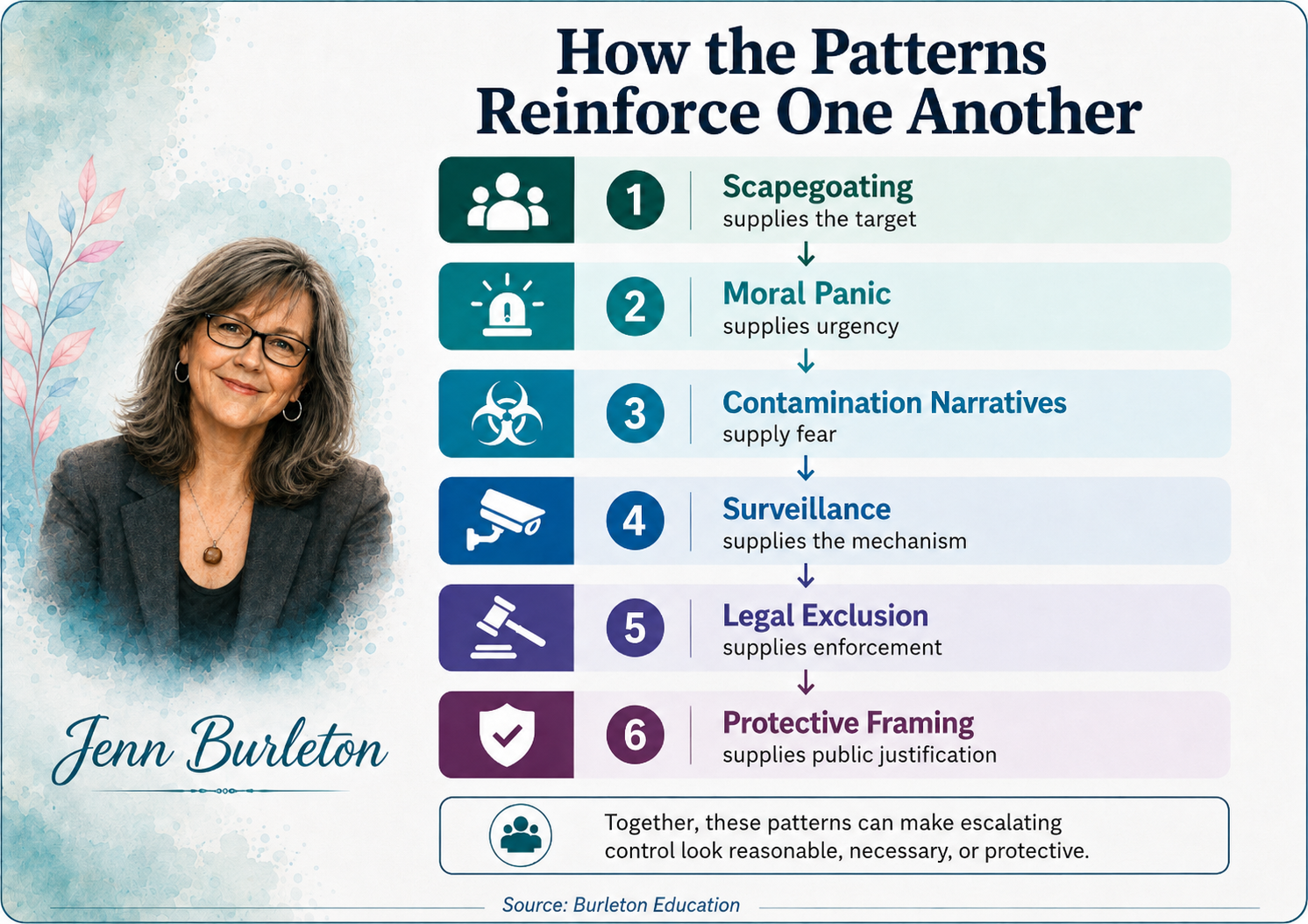
For this resource lane, the relevant question is not whether the past is repeating in exact form. The relevant question is whether familiar mechanisms are appearing again: scapegoating, moral panic, surveillance, censorship, legal exclusion, and the use of public-safety language to justify escalating control.
A minority community is blamed for wider social anxiety, institutional failure, cultural change, or political instability. Complex problems are redirected toward a visible target.
Ordinary presence, speech, care, education, or family life is framed as a threat to children, public morality, safety, or social order.
The targeted community is described as spreading corruption, confusion, ideology, disorder, or danger. Contact itself becomes treated as suspicious.
Schools, agencies, employers, healthcare systems, police, or the public are encouraged to monitor, report, document, or investigate people associated with the targeted group.
Law and policy are used to restrict participation in public life: education, healthcare, employment, travel, documentation, speech, family decision-making, or civic association.
Restrictions, censorship, surveillance, or punishment are presented as necessary protection for children, families, women, public safety, national security, or the social order.
One step supplies the conditions for the next.
Why this framework matters: Genocidal violence does not begin with mass violence. It begins with social permission: sorting people into “us” and “them,” marking them as dangerous, narrowing public sympathy, building systems of monitoring and exclusion, and presenting escalating control as protection. Burleton Education’s warning pattern is designed to identify those earlier civic and political mechanisms before they become normalized.
Although Gregory Stanton’s framework is still commonly known as the “Ten Stages of Genocide,” Stanton has clarified that the model is better understood as a set of overlapping processes, not a simple linear sequence. The processes can operate simultaneously, reinforce one another, and appear at different levels of intensity in different contexts.
Within that scope, the Burleton Education warning pattern correlates most directly with classification, symbolization, discrimination, dehumanization, organization, polarization, and persecution. It does not claim that every civil-rights crisis is genocide. It does show why early warning matters: identification, targeting, deprivation, separation pressure, and rhetoric that justifies or minimizes harm should be recognized before they become normalized.
Burleton correlation: Scapegoating supplies the target.
Classification divides people into “us” and “them.” In the Burleton pattern, scapegoating identifies the group that will be blamed for wider social fear, instability, or institutional failure.
Burleton correlation: Scapegoating and contamination narratives supply labels.
Symbolization attaches names, signs, stereotypes, or social markers to the targeted group. In civil-rights contexts, this may appear through stigmatizing labels that make ordinary identity or advocacy seem suspicious.
Burleton correlation: Legal exclusion supplies enforcement.
Discrimination uses law, policy, or institutional power to deny equal rights or participation. This directly overlaps with legal exclusion in education, healthcare, documentation, family life, employment, speech, or public accommodation.
Burleton correlation: Contamination narratives supply fear.
Dehumanization makes the targeted group seem less fully human, less deserving of dignity, or inherently dangerous. Contamination narratives do this by treating contact, care, education, or support as corrupting or threatening.
Burleton correlation: Surveillance supplies the mechanism.
Organization turns rhetoric into systems. Monitoring, reporting, investigation, data collection, agency coordination, and enforcement structures can convert suspicion into administrative practice.
Burleton correlation: Moral panic and protective framing supply urgency and justification.
Polarization separates communities, punishes moderation, and frames defenders of the targeted group as dangerous or corrupt. Moral panic creates urgency; protective framing presents escalation as necessary defense.
The latter Stanton stages should not be treated as direct equivalents to every civil-rights threat. However, they should also not be treated as irrelevant simply because mass violence has not occurred.
Stage 8, persecution, includes identifiable state-backed processes — targeting, separation, and deprivation — that can appear before exterminatory violence and that may operate alongside earlier stages.
Status in this framework: Potentially enabled/requires caution.
Preparation involves planning and escalation toward mass violence or removal. Burleton Education’s pattern is focused earlier: on civic, rhetorical, legal, and institutional mechanisms that can make preparation easier to justify if not challenged.
Status in this framework: Directly implicated in specific processes.
Persecution involves severe identification, separation, deprivation, or targeting. Legal exclusion and surveillance can move toward persecution when they materially isolate, endanger, or strip rights from a group.
Status in this framework: Not mapped.
Extermination refers to mass killing. Burleton Education’s warning pattern is not a claim that every civil-rights threat is genocide; it is an early-warning tool for recognizing mechanisms that should be interrupted long before mass violence.
Status in this framework: Emerging through rhetoric that justifies or minimizes harm, not mapped as post-atrocity denial.
Denial follows or accompanies atrocities by minimizing harm, shifting blame, destroying evidence, or reframing violence as necessary. In this framework, protective framing can foreshadow denial when rights-stripping, surveillance, or deprivation are described as safety, order, or defense.
Scope note: This correlation is not a claim that every instance of stigma, surveillance, discrimination, or rights-stripping is genocide. It is a civil-rights and atrocity-prevention warning-framework comparison. The purpose is to identify recurring escalation mechanisms early enough for communities, institutions, journalists, educators, and policymakers to interrupt them.
Warning patterns become easier to normalize when they are treated as isolated incidents: one investigation, one school-board fight, one healthcare restriction, one data request, one media narrative, one executive order, one public-safety claim.
This section identifies recurring signals that a civil-rights threat may be escalating from rhetoric into policy, enforcement, surveillance, or material harm.
Watch for official or media language that shifts from describing people to describing a dangerous “ideology,” “agenda,” “movement,” or “threat.”
Watch for demands that schools, healthcare systems, agencies, employers, or families identify, document, report, or investigate transgender, nonbinary, Two-Spirit, or gender-diverse people.
Watch for policies that restrict access to medically recognized care, pressure providers to stop offering care, or make ordinary medical decision-making legally risky for families and clinicians.
Watch for child-protection, custody, abuse, or parental-rights claims being used to threaten families, override affirming medical decisions, or separate young people from supportive adults.
Watch for attempts to place advocacy, protest, education, mutual aid, healthcare access, or community support inside a public-safety, extremism, or counterterrorism frame.
Watch for efforts to target providers, educators, journalists, advocates, mutual-aid networks, libraries, civil-rights organizations, or public officials who support targeted communities.
The danger is rarely one isolated policy or one inflammatory statement. The warning sign is repetition across institutions: when rhetoric, law, enforcement, data collection, media narratives, and public-safety claims begin to point in the same direction.
This resource lane is grounded in a simple civic principle: transgender, nonbinary, Two-Spirit, and gender-diverse people are not threats. Their families, healthcare providers, educators, advocates, and support networks are not extremist infrastructure for recognizing their dignity, protecting their health, or defending their civil rights.
When governments or political movements recode identity, care, advocacy, or community support as danger, they are not merely “debating policy.” They are changing the conditions under which targeted people can live safely, participate openly, access care, remain with supportive families, and rely on ordinary civic protections.
Burleton Education rejects efforts to portray transgender existence, gender-affirming healthcare, family support, public education, civil-rights advocacy, or community care as extremism. Disagreement about policy does not justify surveillance, intimidation, deprivation of care, family disruption, or the use of public-safety frameworks against people seeking to live openly and safely.
The purpose of this resource is not to induce panic. Burleton Education supports pattern recognition, public accountability, and timely response. Communities do not need to wait until harm becomes irreversible before naming the mechanisms that make harm possible.